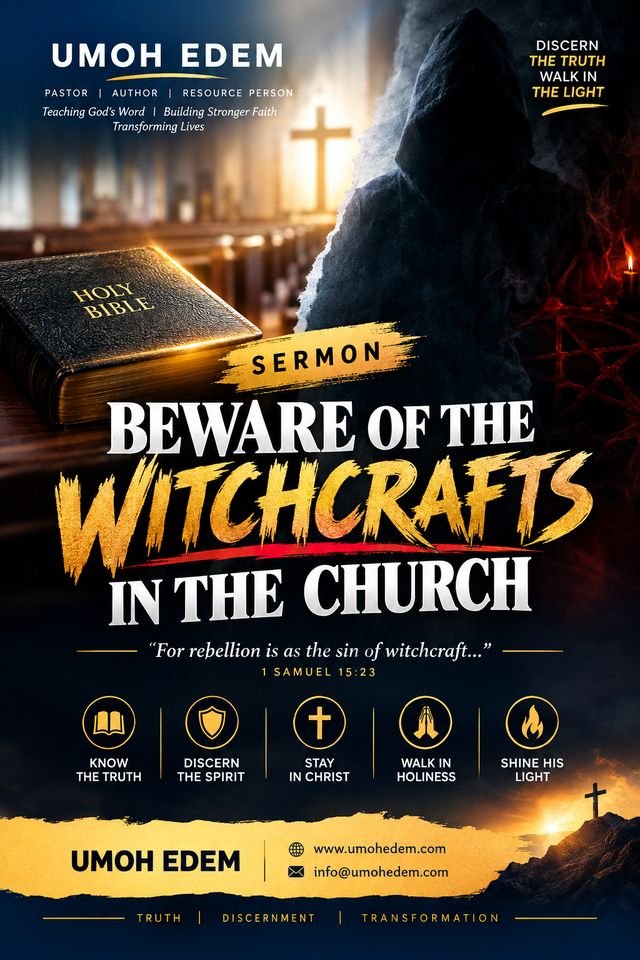
Beware of the Witchcrafts in the Church
Some dangers can appear inside the church, around spiritual activities, leadership, relationships, money, influence, and even ministry.
Read message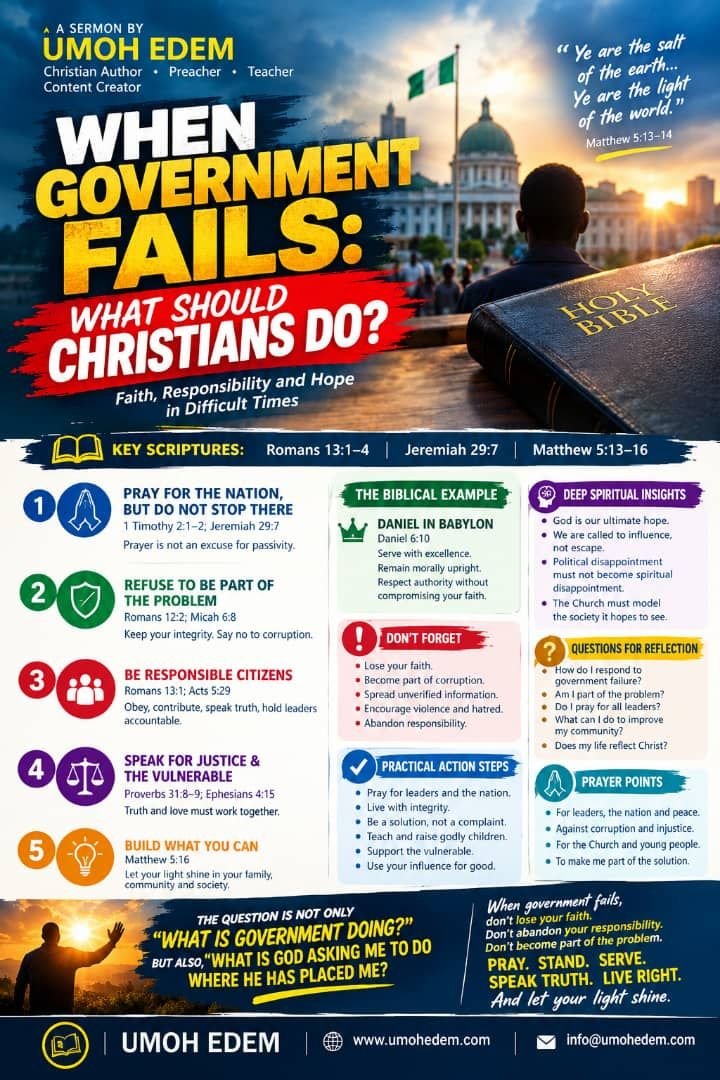
Theme:
Faith, Responsibility and Hope in Difficult Times.
Key Scripture:
Romans 13:1–4; Jeremiah 29:7; Matthew 5:13–16
What should a Christian do when the people in authority fail?
What should we do when corruption increases, justice becomes difficult to find, insecurity threatens communities, young people lose hope, and ordinary citizens feel forgotten?
Do we become bitter?
Do we stop praying?
Do we join the corruption because “everybody is doing it”?
Do we withdraw completely from society?
No!
The failure of government does not cancel the responsibility of the Church.
The Bible never called Christians to become spectators in society. We are called to be salt and light.
Jesus said:
“Ye are the salt of the earth… Ye are the light of the world.” — Matthew 5:13–14
Notice that Jesus did not say, “You are the salt of the church building.”
He said the earth.
Our faith must speak not only on Sunday but also in our homes, workplaces, communities, schools, businesses and society.
When government fails, Christians must not lose their faith, their character, their voice or their responsibility.
“I don’t care about the nation anymore.”
Instead, we should say:
“Lord, intervene. Give leaders wisdom. Restrain evil. Establish justice. Protect the vulnerable. Raise righteous people who will serve with integrity.”
Jeremiah 29:7
God told the Israelites living in Babylon:
“Seek the peace of the city… and pray unto the LORD for it.”
Think about that.
They were living under a government that was not their ideal government.
Yet God told them to pray for the welfare of the city.
Spiritual Insight
Prayer is not an excuse for passivity.
Prayer prepares us to act responsibly.
We pray because we depend on God.
We act because God has given us responsibility.
2. CHRISTIANS MUST REFUSE TO BECOME PART OF THE PROBLEM.
One of the greatest dangers when a society is struggling is that people begin to justify their own wrongdoing.
Someone says:
“Government officials are stealing, so why shouldn’t I steal?”
Another says:
“Everybody gives bribes.
Another says:
“Nobody is honest anymore.”
But the Christian standard is not determined by the behaviour of society.
📖 Romans 12:2
“And be not conformed to this world…”
Your environment does not determine your character.
Corruption around you must not produce corruption within you.
If others lie, tell the truth.
If others exploit people, serve people.
If others steal, remain honest.
If others abuse power, use whatever authority you have responsibly.
📖 Micah 6:8
“He hath shewed thee, O man, what is good; and what doth the LORD require of thee, but to do justly, and to love mercy, and to walk humbly with thy God?”
The Christian response to a broken system is not:
“Let me become broken too.”
It is:
“Let me remain faithful.”
3. CHRISTIANS SHOULD BE RESPONSIBLE CITIZENS.
Christianity does not remove our civic responsibility.
📖 Romans 13:1
“Let every soul be subject unto the higher powers.”
This passage teaches respect for lawful authority.
But Scripture does not teach that government authority is above God.
When human authority directly commands people to disobey God, Scripture gives us another principle.
📖 Acts 5:29
“We ought to obey God rather than men.”
So Christians should neither worship government nor despise government.
We should respect legitimate authority while remaining ultimately accountable to God.
What does responsible citizenship look like?
It includes:
Obeying lawful requirements.
Rejecting corruption.
Paying legitimate taxes and obligations.
Protecting public property.
Speaking truth responsibly.
Helping vulnerable people.
Participating peacefully in civic life.
Holding leaders accountable through lawful means.
Educating ourselves about issues affecting our communities.
Refusing violence and hatred.
Christian citizenship is more than complaining about leaders.
It includes asking:
“What am I doing to make my community better?”
- CHRISTIANS MUST SPEAK FOR JUSTICE AND THE VULNERABLE.
The Church cannot remain silent when people are suffering.
📖 Proverbs 31:8–9
“Open thy mouth for the dumb… Judge righteously, and plead the cause of the poor and needy.”
Biblical Christianity has always had a concern for justice.
The prophets confronted injustice.
John the Baptist confronted wrongdoing.
Jesus defended the vulnerable and challenged hypocrisy.
The Church therefore has a prophetic responsibility.
But there is an important distinction:
Speaking truth is not the same as spreading hatred.
We can challenge injustice without dehumanising people.
We can disagree without becoming violent.
We can demand accountability without destroying our Christian witness.
We can speak courageously while remaining truthful.
Ephesians 4:15“But speaking the truth in love…”
The Church needs truth.
The Church also needs love.
We must never sacrifice one for the other.
5. WHEN SYSTEMS FAIL, BUILD WHAT YOU CAN.
This is where Christian responsibility becomes practical.
Sometimes we spend so much time discussing what government should do that we forget what we can do.
A Christian teacher can educate.
A businessperson can create employment.
A pastor can disciple people.
A parent can raise responsible children.
A young person can develop useful skills.
A professional can serve with integrity.
A church can support vulnerable families.
A Christian organisation can provide educational and humanitarian assistance.
📖 Matthew 5:16
“Let your light so shine before men, that they may see your good works, and glorify your Father which is in heaven.”
Jesus did not say:
“Wait until society becomes perfect before you shine.”
He said:
“Let your light shine.”
Your light may not fix the entire nation.
But it can change your family.
Your family can influence your community.
Your community can influence a city.
And transformation can spread.
Consider Daniel.
Daniel lived under a foreign empire.
He was surrounded by a political system that did not operate according to Israel’s covenant.
Yet Daniel did not respond by becoming useless.
He served with excellence.
He developed wisdom.
He participated in government administration.
He remained morally upright.
And when political pressure demanded that he compromise his relationship with God, Daniel refused.
Daniel 6:10
“He kneeled upon his knees three times a day, and prayed…”
Daniel gives us a powerful model:
He served the government without worshipping the government.
He participated in society without surrendering his convictions.
He respected authority without abandoning God.
That is the balance Christians need.
Engagement without compromise.
Respect without idolatry.
Prayer without passivity.
Courage without violence.
When government fails, don’t:
For young Christians
Learn useful skills.
Refuse examination malpractice and fraud.
Use social media responsibly.
Verify information before sharing it.
Participate peacefully in civic life.
Build businesses and careers that create value.
Become leaders of integrity
For parents
Teach your children:
honesty,
responsibility,
compassion,
respect,
hard work,
biblical morality,
responsible citizenship.
For church leaders
The Church should teach believers:
biblical citizenship,
integrity,
justice,
leadership,
responsible use of technology,
peaceful civic engagement,
care for the vulnerable.
For every Christian
Ask:
“What can I do today to make my corner of society better?”
You may not control the government.
But you can control your integrity.
You may not control national policy.
But you can influence your family.
You may not control the entire economy.
But you can refuse to exploit people.
You may not control society.
But you can let your light shine.
“Some trust in chariots, and some in horses: but we will remember the name of the LORD our God.”
Human governments change.
God does not.
2. Christians are called to influence, not escape.
Jesus called us salt and light.
Salt must make contact.
Light must shine in darkness.
3. Political disappointment must not become spiritual disappointment.
A government can fail.
A leader can fail.
An institution can fail.
But God remains faithful.
4. The Church must model the society it hopes to see.
We cannot demand honesty from government while tolerating dishonesty in our own churches.
We cannot demand accountability from leaders while refusing accountability ourselves.
Transformation begins with personal responsibility.
Beloved, government has a responsibility.
Leaders have responsibilities.
Institutions have responsibilities.
But we also have responsibilities.
Do not spend your entire life asking:
“What is the government doing for me?”
Also ask:
“What is God asking me to do where He has placed me?”
If government fails, the Church must not fail.
If society becomes darker, our light must become brighter.
If corruption increases, our integrity must become stronger.
If people lose hope, we must carry hope.
If injustice becomes common, we must continue to pursue justice.
And if the nation is hurting, we must pray, serve, speak truth and become part of the healing.
Remember:
You are not the government.
You are not the president.
You are not the entire solution.
But you can be faithful where God has placed you.
And sometimes, God changes a nation by first changing one faithful person at a time.
“Ye are the salt of the earth… Ye are the light of the world.” — Matthew 5:13–14
When government fails, don’t lose your faith.
Don’t abandon your responsibility.
Don’t become part of the problem.
PRAY.
STAND.
SERVE.
SPEAK TRUTH.
LIVE RIGHT.
AND LET YOUR LIGHT SHINE.
Give your life to Jesus by joining a Bible believing Church near you.
You can get inspirational ebooks from my websites below
 26 Sep
Some dangers can appear inside the church, around spiritual activities, leadership, relationships, money, influence, and even ministry.
Read message 25 Sep
 24 Sep