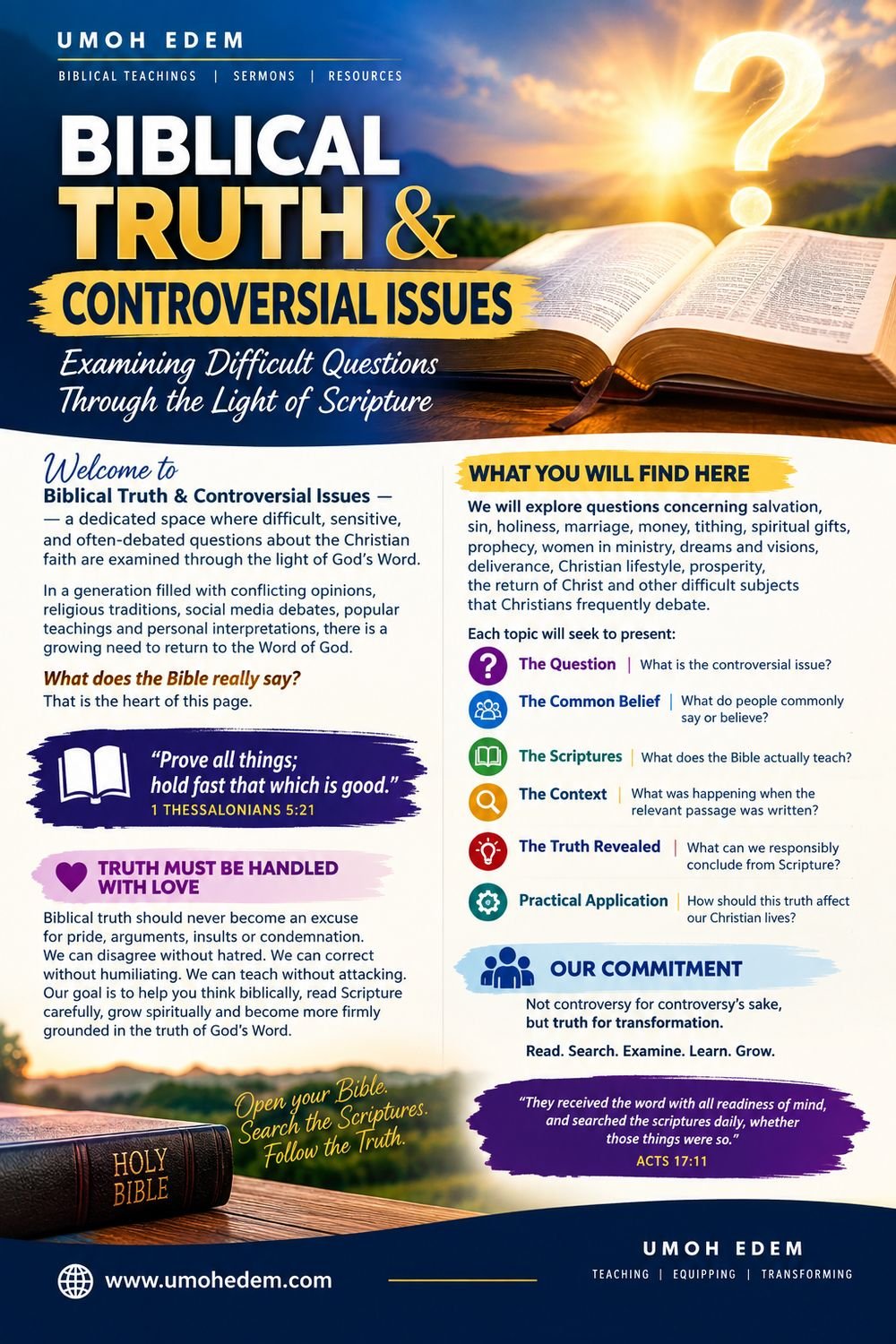
ARE TATTOOS A SIN FOR CHRISTIANS?
ARE TATTOOS A SIN FOR CHRISTIANS?
What Does the Bible Really Say?
Tattoos are one of those subjects that can quickly create disagreement among Christians. Some believers consider every tattoo sinful, while others believe that the Bible does not prohibit tattoos for Christians today.
So, what is the truth?
Are tattoos a sin for Christians?
The answer requires more than quoting one Bible verse. We need to examine Scripture carefully, understand its context, and consider the heart, purpose, and message behind the decision.
1. THE BIBLE DOES MENTION TATTOOS
One of the most commonly quoted passages is:
“Ye shall not make any cuttings in your flesh for the dead, nor print any marks upon you.” — Leviticus 19:28
At first glance, this appears to settle the question. However, we must understand the historical and religious context.
Leviticus 19:28 appears within instructions given to Israel concerning practices associated with mourning and surrounding pagan customs. The verse mentions cutting the flesh “for the dead” and making marks on the body.
Therefore, it is important not to take the verse completely out of its original context and automatically assume that every modern tattoo is precisely the same practice being addressed.
The bigger question is:
Does this Old Testament command directly prohibit every tattoo a Christian might receive today?
That requires further examination.
2. CHRISTIANS ARE NOT UNDER THE MOSAIC LAW
The Old Testament contains many commandments specifically given to the nation of Israel under the Mosaic covenant.
Christians believe that Jesus Christ inaugurated the New Covenant.
“For Christ is the end of the law for righteousness to every one that believeth.” — Romans 10:4
Paul also teaches that believers are not justified by keeping the Mosaic Law but through faith in Christ.
This does not mean that Christians should ignore the Old Testament. The Old Testament remains God’s Word and contains principles concerning holiness, obedience, wisdom, and our relationship with God.
But we must distinguish between commands given specifically within the Mosaic covenant and principles that continue to govern Christian conduct.
Therefore, simply saying, “Leviticus says tattoos are forbidden, therefore every tattoo is automatically a sin,” does not fully address the biblical question.
3. YOUR BODY MATTERS TO GOD
Although Christians are not under the Mosaic Law, Scripture still teaches that our bodies belong to God.
Paul writes:
“Your body is the temple of the Holy Ghost which is in you.” — 1 Corinthians 6:19
And he continues:
“Ye are not your own. For ye are bought with a price: therefore glorify God in your body.” — 1 Corinthians 6:19–20
This gives us an important principle.
The Christian question should not simply be:
“Can I get a tattoo?”
A better question is:
“Will this glorify God?”
What we do with our bodies matters to God.
The design matters.
The message matters.
The motivation matters.
The circumstances matter.
And our conscience matters.
4. WHY DO YOU WANT THE TATTOO?
This may be the most important question.
Two people can receive the same tattoo while having completely different motivations.
One person may choose a tattoo because of rebellion, vanity, peer pressure, occult symbolism, sexual imagery, hatred, or a desire to identify with something contrary to Christian values.
Another person may have a different motivation entirely.
Therefore, Christians should examine the heart.
Ask yourself:
- Why do I want this tattoo?
- Am I doing this because of peer pressure?
- Am I trying to impress people?
- Is the design associated with something ungodly?
- Does it glorify something that contradicts Scripture?
- Would I still want it if nobody else could see it?
- Am I acting from faith or from pressure?
- Can I honestly ask God to be glorified through this decision?
These questions are more spiritually useful than simply asking, “Is tattooing popular?”
5. CONSIDER THE MESSAGE OF THE TATTOO
Not every tattoo carries the same message.
A Christian should be especially cautious about tattoos containing:
- Occult symbols
- Demonic imagery
- Sexual or immoral images
- Hate symbols
- Blasphemous messages
- Idolatrous religious symbols
- Messages celebrating sin or violence
Even if someone argues that tattooing itself is not universally condemned in the New Testament, that does not make every tattoo acceptable.
The content can still be sinful.
A Christian cannot use Christian freedom as an excuse to display something that clearly contradicts Christian holiness.
Paul gives an important principle:
“All things are lawful unto me, but all things are not expedient.” — 1 Corinthians 6:12
Christian freedom should always be controlled by wisdom and love.
6. WHAT ABOUT CHRISTIAN TATTOOS?
Some Christians have tattoos containing crosses, Bible verses, the name of Jesus, or other Christian symbols.
Does the Christian message automatically make the tattoo right?
Not necessarily.
A Christian symbol does not automatically make every motive behind getting it spiritual.
Jesus warned against practicing righteousness merely to be seen by others.
The question is therefore not simply whether the tattoo contains a Bible verse.
The deeper question is:
Why am I doing it, and what does it produce in my life and witness?
A tattoo of a Bible verse does not replace obedience to the Bible.
It is better to live the Word than merely to write the Word on our skin.
7. DO NOT JUDGE PEOPLE SIMPLY BY THEIR TATTOOS
This is another important Christian principle.
A tattoo does not tell you everything about someone’s relationship with God.
Someone may have tattoos and genuinely love Christ.
Someone may have no tattoos and still live in disobedience.
Jesus taught that God looks beyond outward appearance.
Therefore, Christians should avoid making assumptions such as:
“He has tattoos, so he cannot be a true Christian.”
That judgment goes beyond what we can know from someone’s appearance.
At the same time, Christian grace should never become an excuse to ignore biblical holiness.
We must hold truth and grace together.
8. WHAT ABOUT CHRISTIAN CONSCIENCE?
Romans 14 gives us an important principle concerning matters where believers may reach different conclusions.
Paul teaches that believers should not despise or condemn one another over disputable matters.
“Let every man be fully persuaded in his own mind.” — Romans 14:5
This does not mean that everything is morally neutral.
Clear biblical sins remain sins.
But where Scripture does not give a universal New Testament prohibition, believers should exercise wisdom, conscience, love, and self-control.
If you genuinely believe before God that getting a tattoo would violate your conscience, do not do it.
Paul says:
“For whatsoever is not of faith is sin.” — Romans 14:23
Never violate your conscience simply because other people are doing something.
SO, IS GETTING A TATTOO A SIN?
A balanced biblical conclusion:
The Bible explicitly prohibits the making of certain bodily marks in Leviticus 19:28, in the context of practices associated with mourning and ancient religious customs. However, Scripture does not give Christians a direct New Testament command stating that every modern tattoo is automatically sinful.
Therefore, it would be too simplistic to say:
“Every tattoo is a sin.”
But it would also be careless to say:
“Tattoos don’t matter to God.”
They can matter because our motives, choices, bodies, witness, and devotion to God matter.
Before getting a tattoo, a Christian should consider Scripture, conscience, motivation, content, consequences, and whether the decision genuinely honors God.
FIVE QUESTIONS EVERY CHRISTIAN SHOULD ASK BEFORE GETTING A TATTOO
1. Does it contradict Scripture?
If the image or message celebrates something God condemns, don’t do it.
2. What is my motivation?
Is this coming from faith and wisdom, or from rebellion, pressure, insecurity, or the desire for attention?
3. Can I do this for God’s glory?
Paul gives us the principle:
“Whatsoever ye do, do all to the glory of God.” — 1 Corinthians 10:31
4. What does my conscience say?
Never deliberately violate a conscience that is warning you against something.
5. Will this decision help or hinder my Christian witness?
Christian liberty should never be used carelessly if it becomes a stumbling block to others.
FINAL THOUGHT
The Christian life is not about finding the minimum number of things we can do without technically breaking a rule.
It is about asking:
“Lord, how can my life bring You glory?”
Before putting something permanently on your body, take time to put God’s Word permanently in your heart.
A tattoo can be removed—or perhaps not.
But the character we develop, the witness we give, and the obedience we offer to God have consequences far greater than what appears on our skin.
Don’t merely ask, “Is it allowed?”
Ask:
“Is it wise?”
“Is it beneficial?”
“Does it honor Christ?”
“Can I do it in faith?”
“Will God be glorified?”
That is a much deeper question.
BIBLICAL TRUTH
Our bodies belong to God, our decisions should be guided by Scripture, and our freedom should always be submitted to Christ.
“Whether therefore ye eat, or drink, or whatsoever ye do, do all to the glory of God.” — 1 Corinthians 10:31
REFLECTION
If Jesus Christ is Lord over my entire life, should He also influence what I choose to put on my body?
Open your Bible. Search the Scriptures. Pray for wisdom. Examine your heart.
Truth must be handled with love—and Scripture must remain our final authority.
— UMOH EDEM
Biblical Teacher | Christian Author | Gospel Communicator
www.umohedem.com
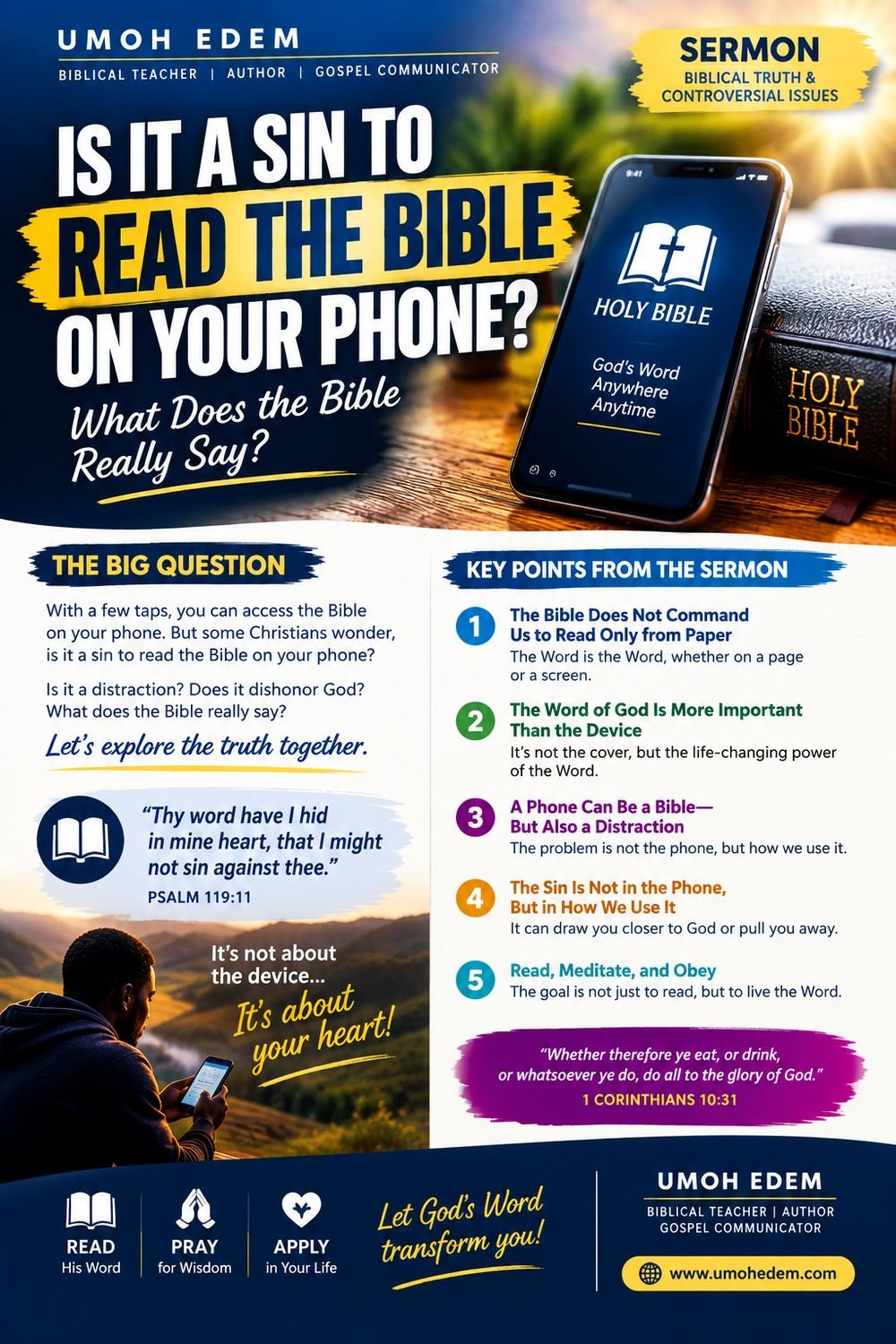
IS IT A SIN TO READ THE BIBLE ON YOUR PHONE?
What Does the Bible Really Say?
There was a time when carrying a Bible meant carrying a physical book.
Today, millions of Christians carry the Bible in their phones.
With a few taps, you can access multiple Bible translations, commentaries, concordances, devotionals, Bible dictionaries, Greek and Hebrew tools, audio Bibles, and reading plans.
Yet a controversial question has emerged:
“Is it a sin to read the Bible on your phone?”
Some Christians say, “No. The Word of God is the Word of God, whether you read it from paper or a screen.”
Others argue that reading the Bible on a phone can easily become a distraction because the same device contains social media, entertainment, games, messages, and other things that can compete for our attention.
So what is the biblical truth?
- THE BIBLE DOES NOT COMMAND US TO READ SCRIPTURE ONLY FROM PAPER
The Bible never says:
“Thou shalt read the Word only from a printed book.”
In fact, the modern printed Bible did not exist in the form we know today when the biblical books were originally written.
Scripture was communicated through different forms and means, including spoken teaching, handwritten manuscripts, scrolls, letters, and public reading.
Paul instructed Timothy:
«“Give attendance to reading, to exhortation, to doctrine.”
— 1 Timothy 4:13»
Notice what Paul emphasizes: reading the Word.
The command is not about the material on which the words are written.
The important issue is receiving, understanding, believing, and obeying God’s Word.
Therefore, there is no biblical basis for declaring that reading the Bible from a phone is inherently sinful.
2. THE WORD OF GOD IS MORE IMPORTANT THAN THE DEVICE.
Imagine two people.
One has a beautiful leather-bound Bible but rarely opens it.
Another has a Bible application on a simple mobile phone and reads Scripture every morning, studies it carefully, prays over it, and obeys what God teaches.
Which one is more pleasing to God?
The answer is not determined by the cover of the Bible.
God is concerned with what happens in the heart and life of the believer.
Jesus said:
«“If ye love me, keep my commandments.”
— John 14:15»
The purpose of Scripture is not merely to become familiar with words.
The Word is meant to transform us.
James says:
«“But be ye doers of the word, and not hearers only.”
— James 1:22»
Therefore, the greatest problem is not whether your Bible is printed or digital.
The greater question is:
Are you allowing the Word of God to change your life?
3. A PHONE CAN BE A BIBLE—BUT IT CAN ALSO BE A DISTRACTION.
Here is where the subject becomes more serious.
A physical Bible generally has one primary purpose: reading Scripture.
A smartphone has many purposes.
Within seconds, you can move from:
Bible → WhatsApp → Facebook → TikTok → YouTube → entertainment → back to the Bible.
That is where the danger lies.
The problem is not necessarily the phone.
The problem can be distraction and lack of discipline.
Jesus said:
«“But take heed to yourselves, lest at any time your hearts be overcharged with surfeiting, and drunkenness, and cares of this life.”
— Luke 21:34»
If your phone constantly interrupts your time with God, you may need to establish boundaries.
You might need to:
- Turn on Do Not Disturb.
- Disable unnecessary notifications.
- Use Bible reading mode.
- Put your phone away after opening the Scripture.
- Download Bible translations for offline reading.
- Set a specific time for Bible study.
- Avoid opening social media before completing your Bible study.
A digital Bible should help you focus on God, not make it easier to escape from Him.
- THE SIN IS NOT IN THE PHONE—BUT IN HOW WE USE IT
A knife can be used to prepare food or to harm someone.
Money can be used to help people or to exploit them.
A house can be used for prayer or for sinful activities.
The object itself does not automatically determine the morality of every action involving it.
The same principle applies to technology.
A phone can be used for:
- Bible study
- Evangelism
- Christian teaching
- Prayer
- Communication
- Research
- Encouragement
But it can also be used for:
- pornography
- gossip
- hatred
- deception
- addiction
- immoral entertainment
- destructive arguments
Therefore, Christians should learn to control technology rather than allowing technology to control them.
Paul says:
«“All things are lawful for me, but I will not be brought under the power of any.”
— 1 Corinthians 6:12»
That is a powerful principle for the digital age.
- WHAT IF SOMEONE SAYS, “A PHONE IS NOT A REAL BIBLE”?
We should be careful here.
A physical Bible is certainly valuable.
There are good reasons to own one.
It can help you concentrate without digital distractions. You can underline passages, write notes in the margins, turn pages, and physically engage with the text.
But saying that a digital Bible is not a Bible at all goes beyond what Scripture teaches.
The Bible is the inspired Word of God.
The phone is simply a medium through which the text is accessed.
The same biblical text can be read from:
- a printed Bible,
- a Bible application,
- a tablet,
- a computer,
- an e-reader,
- or heard through an audio Bible.
The medium changes.
God’s Word does not.
- WHAT ABOUT PEOPLE WHO USE THEIR PHONES DURING CHURCH?
This requires wisdom.
If someone opens a Bible application during a sermon, that can be perfectly legitimate.
But if someone appears to be reading Scripture while actually scrolling through social media, chatting, watching videos, or doing unrelated activities, the problem is no longer the Bible app.
It is distraction and lack of reverence.
Paul teaches:
«“Let all things be done decently and in order.”
— 1 Corinthians 14:40»
Christians should use wisdom in church.
If your phone helps you follow the sermon and Scriptures, use it responsibly.
If your phone repeatedly distracts you, consider using a physical Bible during church services.
7. CAN READING THE BIBLE ON YOUR PHONE STILL BE A SPIRITUAL EXPERIENCE?
Absolutely.
Your spiritual encounter with God’s Word does not depend on whether the words appear on paper or a screen.
Jesus said:
«“The words that I speak unto you, they are spirit, and they are life.”
— John 6:63»
A person can read a printed Bible without paying attention.
Another person can read Scripture from a phone with tears in their eyes, kneel down, pray, repent, and surrender their life to Christ.
The power is not in the paper.
The power is not in the screen.
The transformation comes from God working through His Word by His Spirit.
8. BUT DON’T LET DIGITAL READING REPLACE DEEP BIBLE STUDY.
There is another danger.
Because smartphones make Scripture so convenient, people can become Bible samplers instead of Bible students.
They read a verse here.
A quotation there.
A devotional somewhere else.
Then move on.
But biblical maturity requires more than collecting inspirational verses.
Paul told Timothy:
«“Study to shew thyself approved unto God, a workman that needeth not to be ashamed, rightly dividing the word of truth.”
— 2 Timothy 2:15»
Whether you use a phone or a printed Bible, learn to study Scripture in context.
Ask:
Who wrote this?
To whom was it written?
What was happening?
What does the passage actually mean?
How does it fit with the rest Scripture?
How should I apply it to my life?
That is genuine Bible study.
- THE BIBLE ON YOUR PHONE SHOULD NOT BECOME A SUBSTITUTE FOR OBEDIENCE.
One of the greatest dangers in Christianity is confusing access to Scripture with obedience to Scripture.
You can have 50 Bible translations on your phone and still refuse to forgive someone.
You can have thousands of sermons saved and still refuse to obey God.
You can highlight hundreds of verses and still live contrary to God’s Word.
Jesus said:
«“Why call ye me, Lord, Lord, and do not the things which I say?”
— Luke 6:46»
The goal is not simply:
“I read the Bible today.”
The deeper question is:
“What did the Bible I read today change about me?”
10. THERE IS A DIFFERENCE BETWEEN READING AND MEDITATING
Sometimes we rush through Bible reading simply to complete our daily reading plan.
But God wants His Word to dwell deeply within us.
Psalm 1:2 says:
«“But his delight is in the law of the LORD; and in his law doth he meditate day and night.”»
Meditation involves slowing down.
Read the verse.
Understand it.
Think about it.
Pray about it.
Apply it.
Ask God what needs to change.
You may read five chapters on your phone and remember almost nothing.
Someone else may read five verses slowly and allow those verses to transform their thinking.
Quality matters, not merely quantity.
11. WHAT IF MY PHONE IS THE ONLY BIBLE I HAVE?
Then use it.
Do not allow the absence of a physical Bible to become an excuse for not reading God’s Word.
If your phone gives you access to Scripture, take advantage of that opportunity.
Jesus said:
«“Man shall not live by bread alone, but by every word that proceedeth out of the mouth of God.”
— Matthew 4:4»
If the Bible is available to you digitally, read it.
If you later have the opportunity to obtain a physical Bible, that is also valuable.
The important thing is not to neglect God’s Word.
12. SHOULD EVERY CHRISTIAN ALSO OWN A PHYSICAL BIBLE?
While it is not a biblical requirement, I recommend it.
Having a physical Bible can be useful for:
- serious study
- church services
- memorization
- note-taking
- reducing digital distractions
- reading without notifications
- building a personal library
- teaching others
But owning a physical Bible should never become a reason to condemn someone who reads Scripture digitally.
Use both if you can.
Let the physical Bible strengthen your study.
Let the digital Bible increase your accessibility.
Let neither become a substitute for obedience.
THE CONTROVERSIAL QUESTION.
“Is reading the Bible on your phone a sin?”
Biblical answer: NO—not by itself.
There is no biblical command that says Christians sin when they read Scripture from a phone.
However, how you use the phone can become sinful.
If you use the device to read Scripture, learn God’s Word, pray, and grow spiritually, there is nothing inherently sinful about that.
But if your phone continually leads you into pornography, hatred, gossip, addiction, envy, distraction, or other sinful behavior, then the issue must be taken seriously.
The Christian should examine not only what the device is, but what the device is producing in his or her life.
7 PRACTICAL RULES FOR READING THE BIBLE ON YOUR PHONE.
- Put God First
Do not allow notifications to become more important than God’s Word. - Remove Distractions
Use airplane mode or Do Not Disturb when necessary. - Read in Context
Do not build doctrines around isolated verses. - Take Notes
Record what God is teaching you. - Pray Before Reading
Ask the Holy Spirit for understanding and wisdom. - Practice What You Read
Knowledge without obedience produces little spiritual growth. - Use a Physical Bible When Helpful
If your phone consistently distracts you, put it down and open a physical Bible.
FINAL VERDICT.
Reading the Bible on your phone is not a sin.
The phone is simply a tool.
The greater issue is how you use the tool, what controls your attention, what enters your heart, and whether God’s Word is producing obedience in your life.
Don’t become so religious about the cover of the Bible that you forget the content of the Bible.
And don’t become so comfortable with a digital Bible that you allow your phone to distract you from the God whose Word you are reading.
Whether the Bible is in your hand or on your screen, the command remains the same:
«“Thy word have I hid in mine heart, that I might not sin against thee.”
— Psalm 119:11»
REMEMBER:
A Bible in your hand is good.
A Bible on your phone is useful.
But God’s Word in your heart—and God’s Word lived through your life—is the goal.
REFLECTION QUESTIONS.
- When I open my phone to read the Bible, do I actually focus on Scripture?
- Does my phone help my spiritual life or regularly distract me from God?
- Am I reading God’s Word merely to complete a plan, or am I allowing it to transform me?
- What did I read recently that I actually put into practice?
- Is there anything on my phone that I need to remove because it continually leads me into temptation?
PRAYER.
Father, thank You for giving us access to Your Word. Give me wisdom to use technology in a way that glorifies You. Help me not only to read Your Word but to understand it, believe it, obey it, and live by it. Guard my eyes, my mind, and my heart from every distraction and temptation. Let Your Word dwell richly within me and transform my life. In Jesus’ name, Amen.
— UMOH EDEM
Biblical Teacher | Christian Author | Gospel Communicator
CAN A CHRISTIAN LOSE HIS OR HER SALVATION?
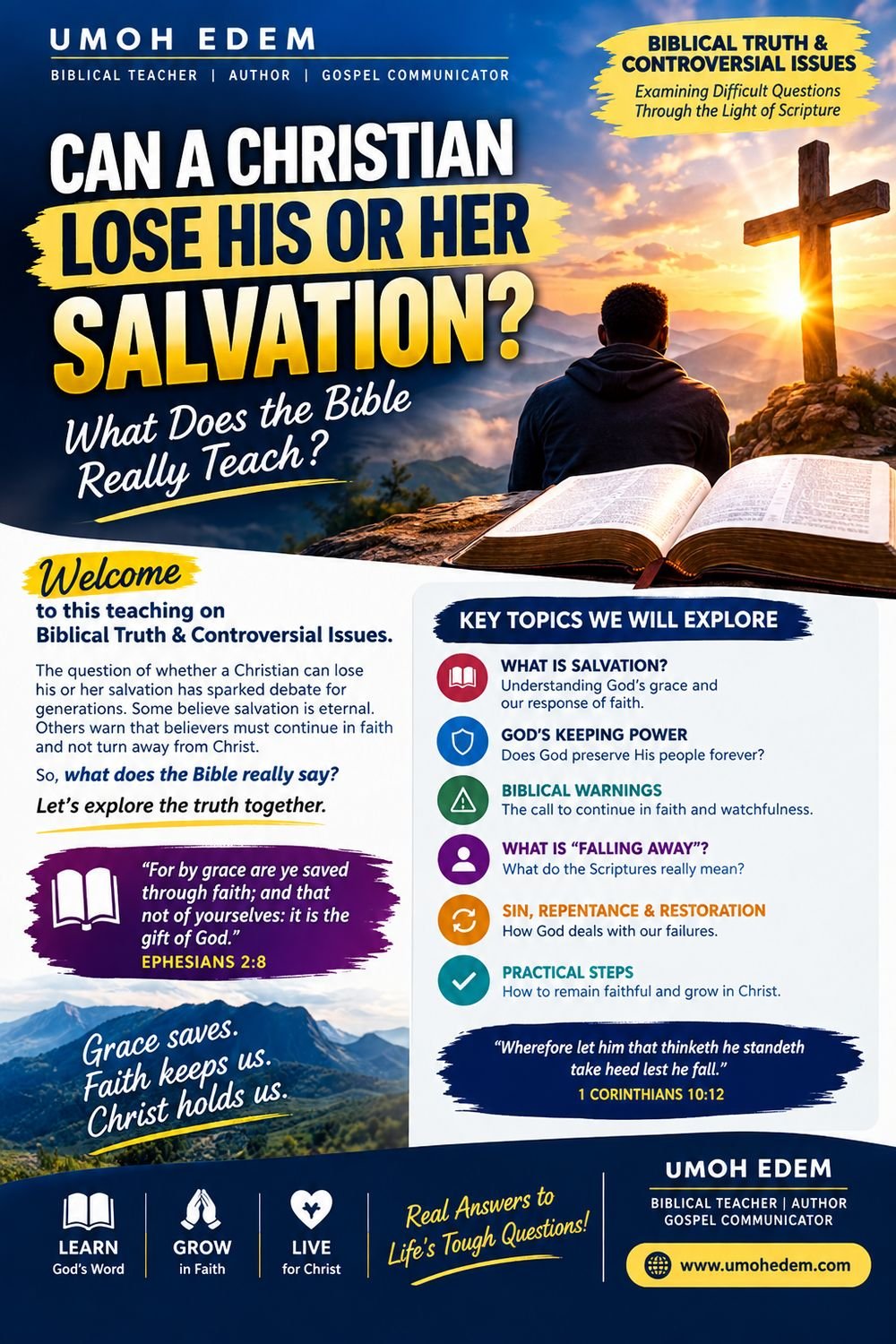
CAN A CHRISTIAN LOSE HIS OR HER SALVATION?
What Does the Bible Really Teach?
Few questions create as much discussion among Christians as this:
“Once a person is genuinely saved, can that person ever lose salvation?”
Some Christians answer, “No. Once you are truly saved, you are eternally secure in Christ.”
Others answer, “Yes. Scripture repeatedly warns believers that they must continue in faith and not turn away from Christ.”
Both sides appeal to Scripture.
So how should we approach this question?
We must not build our conclusion around one isolated verse. We need to examine the whole biblical testimony—God’s grace, human faith, perseverance, warnings against apostasy, God’s keeping power, and the promises made to those who belong to Christ.
- FIRST, WHAT IS SALVATION?
Before asking whether salvation can be lost, we need to understand what salvation is.
Salvation is God’s gracious work of rescuing sinners from sin and bringing them into a right relationship with Himself through Jesus Christ.
Paul writes:
«“For by grace are ye saved through faith; and that not of yourselves: it is the gift of God.”
— Ephesians 2:8»
Salvation is therefore not something we earn by good works.
We do not purchase salvation.
We do not deserve salvation.
We receive salvation through God’s grace and faith in Jesus Christ.
But salvation also produces a transformed life.
Paul continues:
«“For we are his workmanship, created in Christ Jesus unto good works.”
— Ephesians 2:10»
Therefore, biblical salvation is not merely saying a prayer, joining a church, or carrying the name “Christian.”
It involves a genuine relationship with Christ.
- SCRIPTURE CONTAINS STRONG PROMISES OF GOD’S KEEPING POWER.
One reason many Christians believe salvation is eternally secure is because Scripture contains powerful promises concerning God’s ability to keep those who belong to Him.
Jesus said:
«“And I give unto them eternal life; and they shall never perish, neither shall any man pluck them out of my hand.”
— John 10:28»
Jesus also said:
«“My Father, which gave them me, is greater than all; and no man is able to pluck them out of my Father’s hand.”
— John 10:29»
These verses emphasize the security believers have in Christ.
The apostle Paul also wrote:
«“Being confident of this very thing, that he which hath begun a good work in you will perform it until the day of Jesus Christ.”
— Philippians 1:6»
Peter describes believers as:
«“Kept by the power of God through faith unto salvation.”
— 1 Peter 1:5»
These passages provide substantial biblical grounds for confidence in God’s faithfulness and His power to preserve His people.
- BUT THE BIBLE ALSO CONTAINS SERIOUS WARNINGS TO BELIEVERS.
Here is where the discussion becomes difficult.
The New Testament does not merely tell Christians, “You are secure.”
It also repeatedly tells believers to remain faithful.
Jesus said:
«“But he that shall endure unto the end, the same shall be saved.”
— Matthew 24:13»
Paul warned the Corinthian believers:
«“Wherefore let him that thinketh he standeth take heed lest he fall.”
— 1 Corinthians 10:12»
Hebrews says:
«“Take heed, brethren, lest there be in any of you an evil heart of unbelief, in departing from the living God.”
— Hebrews 3:12»
These are not casual statements.
They are serious warnings about continuing in faith.
The Bible therefore gives believers both:
Promises of God’s keeping power
and
Warnings against abandoning faith.
A responsible study must take both seriously.
- WHAT DOES “FALLING AWAY” MEAN?
This is one of the central questions.
The New Testament uses strong language concerning people who turn away from Christ.
Hebrews 6 speaks about people who have experienced profound spiritual realities and then fall away.
«“If they shall fall away, to renew them again unto repentance.”
— Hebrews 6:6»
Hebrews 10 gives another solemn warning:
«“For if we sin wilfully after that we have received the knowledge of the truth, there remaineth no more sacrifice for sins.”
— Hebrews 10:26»
Jesus also warned about people who appear to follow Him but ultimately do not remain faithful.
This raises an important interpretive question:
Are these passages describing genuine believers who can finally lose salvation, or are they describing people who have experienced the blessings and realities surrounding the Christian community without possessing saving faith in the fullest sense?
Christians answer this differently.
That distinction should be acknowledged rather than ignored.
- TWO MAJOR CHRISTIAN UNDERSTANDINGS
VIEW ONE: ETERNAL SECURITY.
Those who hold this position emphasize God’s sovereign grace and His power to preserve genuine believers.
They point to passages such as:
- John 10:27–29
- Romans 8:28–39
- Philippians 1:6
- Ephesians 1:13–14
- 1 Peter 1:3–5
Romans 8 contains one of the strongest statements of confidence in God’s saving work:
«“For I am persuaded, that neither death, nor life… shall be able to separate us from the love of God, which is in Christ Jesus our Lord.”
— Romans 8:38–39»
From this perspective, a person who genuinely belongs to Christ will ultimately be preserved by God’s grace.
When such a person falls into sin, God disciplines, corrects, and restores them rather than allowing them ultimately to perish.
This view therefore emphasizes:
God’s faithfulness.
- VIEW TWO: SALVATION MUST BE PERSEVERED IN.
Other Christians emphasize the biblical warnings about turning away from Christ.
They point to passages such as:
- Hebrews 3:12–14
- Hebrews 6:4–6
- Hebrews 10:26–29
- 2 Peter 2:20–22
- Colossians 1:22–23
- Matthew 24:13
Paul tells the Colossians:
«“If ye continue in the faith grounded and settled, and be not moved away from the hope of the gospel.”
— Colossians 1:23»
From this perspective, God’s grace is essential, but believers must genuinely continue in faith.
The Christian life is not a one-time profession followed by deliberate rejection of Christ without consequence.
This view therefore emphasizes:
The believer’s responsibility to remain faithful to Christ.
- WHAT ABOUT A CHRISTIAN WHO COMMITS A SERIOUS SIN?
This is where many people become confused.
Suppose a genuine Christian falls into adultery.
Or lies.
Or steals.
Or becomes addicted.
Or becomes angry and bitter.
Or walks away from church for a season.
Does that automatically mean the person has lost salvation?
The Bible does not teach that every individual act of sin automatically causes a believer to lose salvation.
Christians still struggle with sin.
John wrote to believers:
«“If we say that we have no sin, we deceive ourselves, and the truth is not in us.”
— 1 John 1:8»
But John immediately gives hope:
«“If we confess our sins, he is faithful and just to forgive us our sins, and to cleanse us from all unrighteousness.”
— 1 John 1:9»
The issue, therefore, is not simply:
“Did you ever sin after becoming a Christian?”
The deeper issue is:
“What is your relationship with sin, Christ, repentance, and faith?”
A believer may stumble.
But Scripture calls believers to repentance and continued faithfulness.
- REPENTANCE IS NOT OPTIONAL.
Grace does not mean that sin no longer matters.
Paul asks:
«“Shall we continue in sin, that grace may abound?”»
His answer is:
«“God forbid.”
— Romans 6:1–2»
A person cannot reasonably use the doctrine of eternal security as permission to live deliberately and permanently in rebellion against God.
The grace that saves us also calls us to transformation.
Jesus said:
«“If ye love me, keep my commandments.”
— John 14:15»
Therefore:
“I am saved” should never become an excuse for “I can live however I want.”
- WHAT ABOUT PETER?
Peter gives us an important biblical example.
Peter denied Jesus three times.
This was a serious failure.
Jesus had warned Peter:
«“Before the cock crow, thou shalt deny me thrice.”
— Matthew 26:34»
And Peter did exactly that.
But Peter was restored.
After His resurrection, Jesus deliberately restored Peter in John 21.
This teaches us something important:
A believer’s serious failure does not automatically mean that restoration is impossible.
There is a difference between:
falling into sin
and
deliberately abandoning Christ and refusing repentance.
Peter fell badly—but he was restored.
God’s mercy is greater than the failure of a repentant believer.
- WHAT ABOUT JUDAS?
Judas Iscariot presents a very different and difficult case.
Judas followed Jesus.
He was among the twelve disciples.
He participated in the ministry.
But ultimately he betrayed Jesus.
Jesus said concerning him:
«“It had been good for that man if he had not been born.”
— Matthew 26:24»
Judas reminds us that outward association with Jesus is not necessarily the same thing as genuine saving faith.
A person can:
- attend church,
- preach,
- sing,
- serve,
- know Scripture,
- associate with Christians,
and still have a heart that has not truly surrendered to Christ.
Therefore, the question is not merely:
“Did I once make a profession?”
The deeper question is:
“Do I genuinely belong to Christ?”
- WHAT DOES IT MEAN TO “ENDURE TO THE END”?
Jesus said:
«“He that shall endure unto the end, the same shall be saved.”
— Matthew 24:13»
Christianity is not merely about how you begin.
It is also about how you continue.
We are called to:
- continue believing,
- continue following Christ,
- continue repenting,
- continue growing,
- continue obeying,
- continue trusting God’s grace.
Hebrews 3:14 says:
«“For we are made partakers of Christ, if we hold the beginning of our confidence stedfast unto the end.”»
This is why Christians should never become careless about their spiritual lives.
- DON’T LIVE IN CONSTANT FEAR OF LOSING SALVATION.
There is another extreme we must avoid.
Some sincere Christians wake up every morning terrified:
“Maybe God has rejected me.”
“Maybe I lost my salvation because I sinned yesterday.”
“Maybe God doesn’t love me anymore.”
That kind of fear can destroy the joy and confidence that Scripture gives believers.
Romans 8:1 says:
«“There is therefore now no condemnation to them which are in Christ Jesus.”»
The Christian should take sin seriously—but should also take God’s mercy seriously.
If you have sinned, run toward God, not away from Him.
Confess your sin.
Repent.
Receive His forgiveness.
Get back up.
Continue following Christ.
- DON’T USE ETERNAL SECURITY AS A LICENSE FOR SIN.
The opposite error is equally dangerous.
Someone may say:
«“I prayed the sinner’s prayer years ago, so I can live however I want. Nothing I do matters.”»
That attitude contradicts the transforming nature of salvation.
Paul writes:
«“If any man be in Christ, he is a new creature.”
— 2 Corinthians 5:17»
A genuine encounter with Christ should produce spiritual fruit.
Jesus said:
«“Ye shall know them by their fruits.”
— Matthew 7:16»
The evidence of salvation is not merely a past date on a calendar.
It includes a continuing relationship with Christ.
- SALVATION IS BY GRACE—BUT GRACE PRODUCES A CHANGED LIFE.
We must hold two biblical truths together.
TRUTH ONE:
We are saved by God’s grace through faith.
Ephesians 2:8–9 makes this clear.
TRUTH TWO:
Saving faith produces a life of obedience and transformation.
James 2 emphasizes that faith that never produces works is dead.
This does not mean that our good works purchase salvation.
They do not.
Rather, good works are evidence that genuine faith is alive.
A healthy tree produces fruit.
The fruit does not make the tree alive.
The living tree produces the fruit.
- SO, CAN A CHRISTIAN LOSE SALVATION?
The most responsible biblical answer is this:
Christians disagree on whether a genuinely regenerated believer can finally lose salvation.
One major Christian position teaches that genuine believers are eternally secure because God preserves them to the end.
Another major position teaches that believers must continue in faith and that persistent, deliberate rejection of Christ can result in final apostasy.
Both positions appeal to significant biblical passages.
Therefore, this question should not be handled carelessly or reduced to a slogan.
What Scripture clearly teaches is that:
God is faithful.
Christ is able to save.
Believers are called to continue in faith.
Christians are warned against falling away.
Sin must not be treated lightly.
Repentance remains essential.
Those who belong to Christ should persevere in faith.
And the believer’s confidence should ultimately rest in God’s grace and faithfulness, not in human pride.
- WHAT SHOULD A CHRISTIAN DO?
Instead of spending all your energy asking:
“How close can I get to losing salvation?”
Ask:
“How can I remain close to Jesus?”
- REMAIN IN CHRIST
Jesus said:
«“Abide in me, and I in you.”
— John 15:4»
- STUDY GOD’S WORD.
«“As newborn babes, desire the sincere milk of the word, that ye may grow thereby.”
— 1 Peter 2:2»
- PRAY CONSISTENTLY
Maintain your relationship with God through prayer.
- REPENT QUICKLY.
When you fall, do not hide from God.
Return to Him.
- GUARD YOUR FAITH.
Be careful about teachings, relationships, habits, and influences that pull you away from Christ.
- OBEY CHRIST.
Don’t merely hear God’s Word.
Practice it.
- PERSEVERE.
Keep following Jesus when life becomes difficult.
FINAL THOUGHT.
Perhaps the better question is not simply:
“Can I lose my salvation?”
There is a deeper question:
“Am I truly abiding in Christ?”
Jesus said:
«“Abide in me, and I in you.”
— John 15:4»
The Christian life is not about becoming careless because we believe we are secure.
Neither is it about living in terror that God will abandon us every time we stumble.
It is about walking with Christ, trusting His grace, responding to His correction, repenting when we fall, and persevering in faith.
If you have fallen, come back to Christ.
If you are struggling, keep trusting Him.
If you have become spiritually careless, wake up.
If you are living in fear, remember God’s mercy.
And if you claim to belong to Christ, let your life demonstrate that claim.
«“Let us hold fast the profession of our faith without wavering; (for he is faithful that promised).”
— Hebrews 10:23»
A WORD OF ENCOURAGEMENT.
Don’t run away from God because you have fallen. Run back to Him.
Peter failed and was restored.
David sinned and repented.
The prodigal son returned to his father.
The message of the Gospel is not that Christians never fall.
The message is that God calls us to repentance, restoration, faith, and continued fellowship with Him.
REFLECTION QUESTIONS.
- Am I genuinely following Christ, or am I relying only on a past religious experience?
- Has my faith produced visible changes in my character?
- Is there any area of deliberate sin that I need to surrender to God?
- When I fall, do I run toward God or hide from Him?
- Am I continuing in faith when circumstances become difficult?
- What evidence can I see that I am growing spiritually?
PRAYER.
Father, thank You for the gift of salvation through Jesus Christ. Help me never to treat Your grace casually. Strengthen my faith, keep my heart close to You, and help me persevere until the end. When I fall, give me the humility to repent. When I am discouraged, remind me of Your faithfulness. When temptation comes, give me strength to overcome. Help me abide in Christ and produce fruit that glorifies Your name. In Jesus’ name, Amen.
BIBLICAL TRUTH.
Salvation is God’s gracious gift in Christ. Therefore, let us neither take God’s grace for granted nor live in unnecessary fear. Let us trust Christ, abide in Him, repent when we fall, and persevere in faith.
Read the Scriptures. Examine the context. Pray for understanding. And let God’s Word shape your life.
— UMOH EDEM
Biblical Teacher | Christian Author | Gospel Communicator
BIBLICAL TRUTH & CONTROVERSIAL ISSUES.
Examining Difficult Questions Through the Light of Scripture
THE BENEFITS OF SALVATION
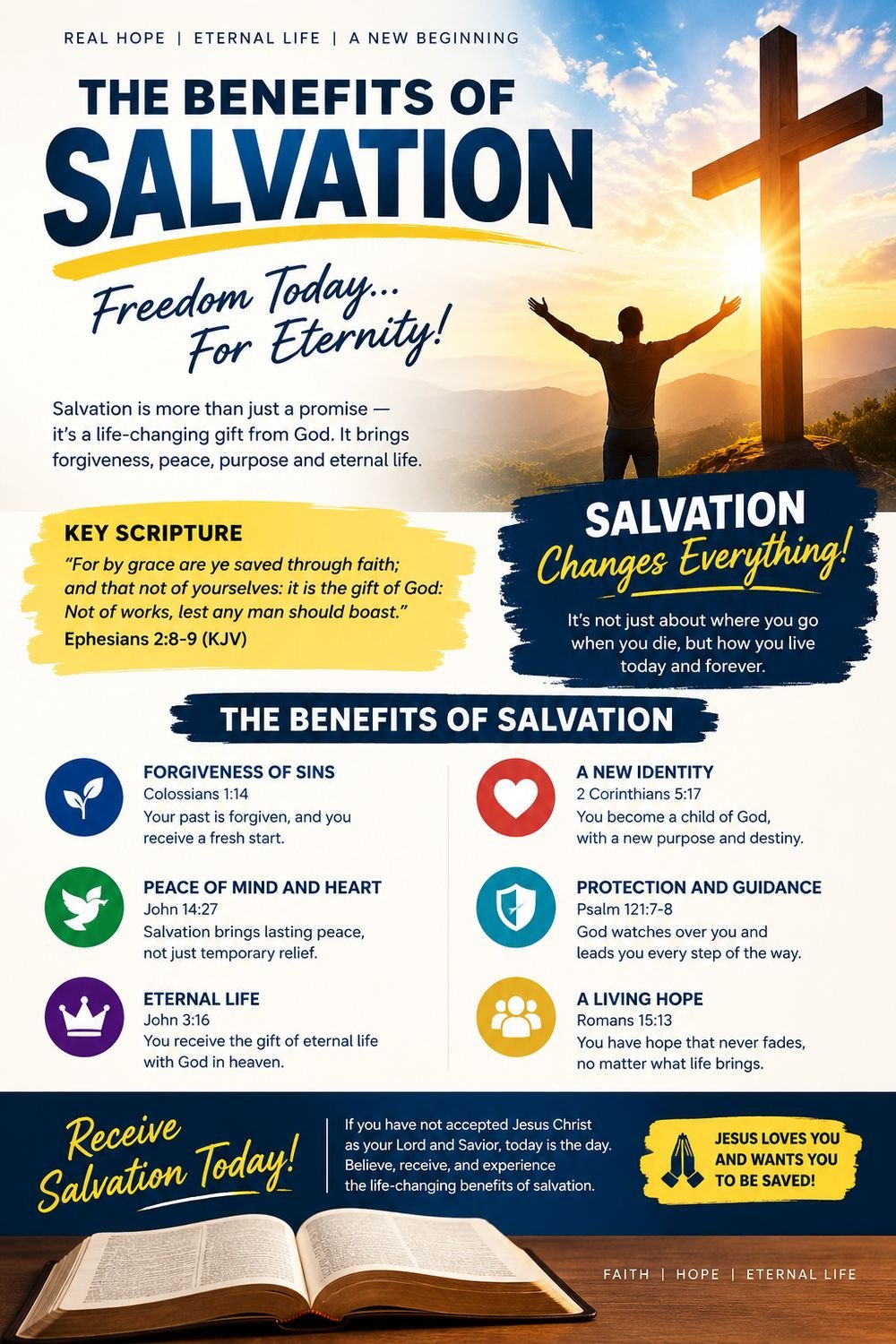
THE BENEFITS OF SALVATION.
Key Scripture.
“For by grace are ye saved through faith; and that not of yourselves: it is the gift of God.”
— Ephesians 2:8 (KJV)
INTRODUCTION.
Salvation is the greatest gift God has given to humanity through Jesus Christ. It is more than escape from hell; it is a complete transformation of life, destiny, and relationship with God. When a person receives salvation, they step into divine benefits that affect both earthly living and eternal destiny.
LESSON POINTS.
- Forgiveness of Sins
“In whom we have redemption through his blood, the forgiveness of sins…”
— Ephesians 1:
Salvation washes away all sins—past, present, and future. The believer is no longer condemned or guilty before God.
Benefit: Freedom from guilt, shame, and condemnation.
2. New Life in Christ
“Therefore if any man be in Christ, he is a new creature…”
— 2 Corinthians 5:17
Salvation brings spiritual rebirth. The old sinful nature is replaced with a new life empowered by the Holy Spirit.
Benefit: A transformed heart, new desires, and a new purpose.
3. Reconciliation with God
“Being justified by faith, we have peace with God through our Lord Jesus Christ.”
— Romans 5:1
Salvation restores broken fellowship between God and man. We become God’s children and friends.
Benefit: Peace with God and intimate relationship with Him.
4. Assurance of Eternal Life
“And this is the promise that he hath promised us, even eternal life.”
— 1 John 2:25
Salvation guarantees life after death with God in heaven.
Benefit: Hope beyond the grave and victory over fear of death.
5. Freedom from the Power of Sin
“For sin shall not have dominion over you…”
— Romans 6:14
Salvation not only forgives sin but also empowers believers to overcome sin daily.
Benefit: Victory over sinful habits and bondage.
- Access to God’s Blessings and Promises
“All the promises of God in him are yea, and in him Amen.”
— 2 Corinthians 1:20
Salvation gives believers access to divine provision, guidance, protection, and favor.
Benefit: A life supported by God’s promises.
- Citizenship in God’s Kingdom
“Now therefore ye are no more strangers and foreigners, but fellowcitizens with the saints…”
— Ephesians 2:19
The saved belong to God’s kingdom and family.
Benefit: Identity, belonging, and spiritual authority.
QUESTIONS AND ANSWERS.
Q1: Is salvation earned by good works?
A: No. Salvation is a gift received by faith in Jesus Christ (Ephesians 2:8–9).
Q2: Can salvation be lost easily?
A: Salvation is secure in Christ, but believers must continue in faith and obedience (John 10:28).
Q3: Does salvation change daily living?
A: Yes. True salvation produces a transformed lifestyle and godly character (Titus 3:5).
Q4: Is salvation for everyone?
A: Yes. God desires all to be saved, but each person must personally accept Christ (John 3:16).
CALL TO ACTION.
If you are not saved, receive Jesus Christ today as your Lord and Savior.
If you are saved, live out the benefits of salvation by walking in holiness and obedience.
Share the message of salvation with others.
Study God’s Word to fully understand and enjoy your inheritance in Christ.
“Today, if you hear His voice, do not harden your heart.” — Hebrews 3:
Always Follow
TRUTH REVEALED TEACHING GROUP (TRTG)
For More Information, Teachings, and Spiritual G.
THE BENEFITS OF SALVATION
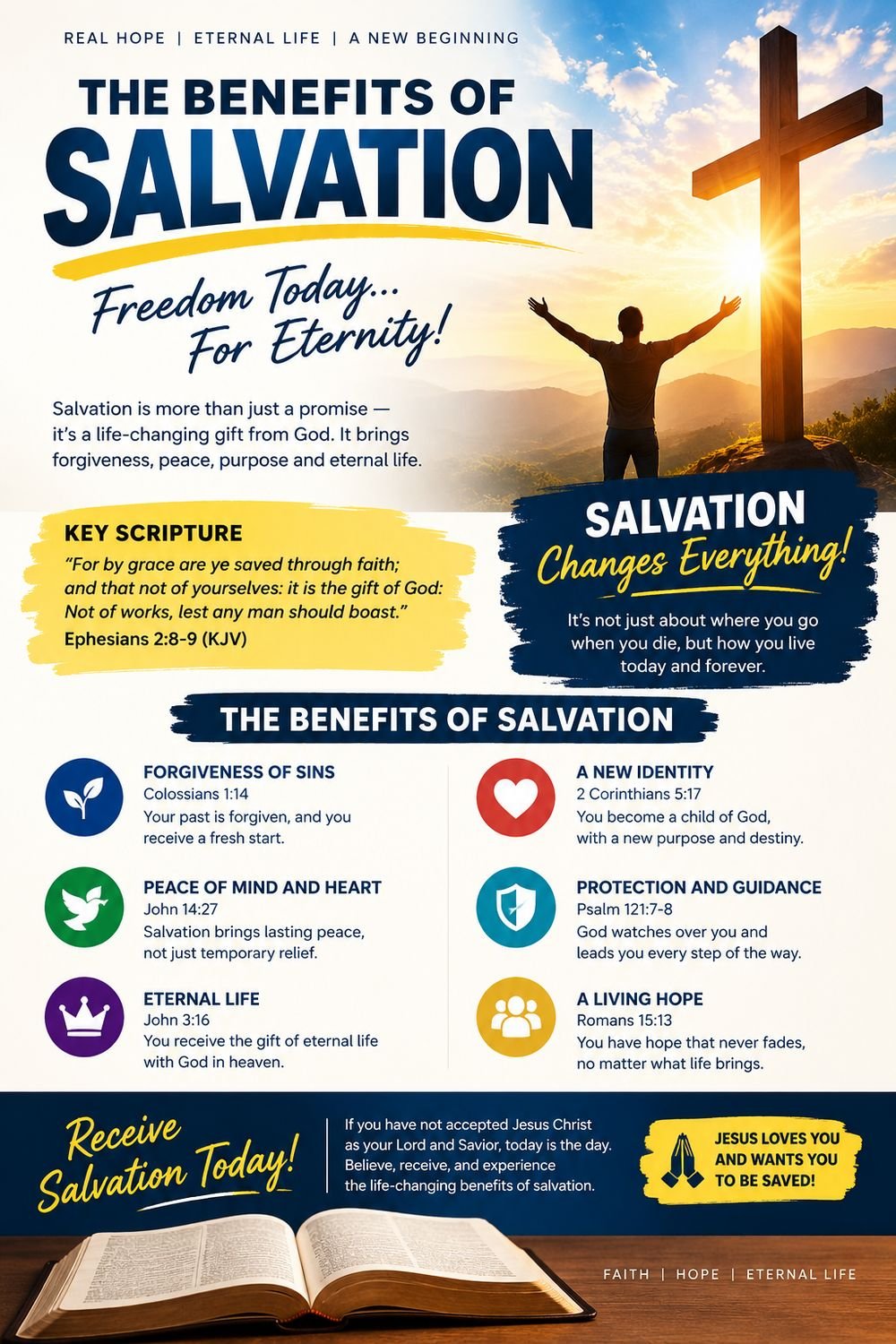
THE BENEFITS OF SALVATION.
Key Scripture.
“For by grace are ye saved through faith; and that not of yourselves: it is the gift of God.”
— Ephesians 2:8 (KJV)
INTRODUCTION.
Salvation is the greatest gift God has given to humanity through Jesus Christ. It is more than escape from hell; it is a complete transformation of life, destiny, and relationship with God. When a person receives salvation, they step into divine benefits that affect both earthly living and eternal destiny.
LESSON POINTS.
- Forgiveness of Sins
“In whom we have redemption through his blood, the forgiveness of sins…”
— Ephesians 1:
Salvation washes away all sins—past, present, and future. The believer is no longer condemned or guilty before God.
Benefit: Freedom from guilt, shame, and condemnation.
2. New Life in Christ
“Therefore if any man be in Christ, he is a new creature…”
— 2 Corinthians 5:17
Salvation brings spiritual rebirth. The old sinful nature is replaced with a new life empowered by the Holy Spirit.
Benefit: A transformed heart, new desires, and a new purpose.
3. Reconciliation with God
“Being justified by faith, we have peace with God through our Lord Jesus Christ.”
— Romans 5:1
Salvation restores broken fellowship between God and man. We become God’s children and friends.
Benefit: Peace with God and intimate relationship with Him.
4. Assurance of Eternal Life
“And this is the promise that he hath promised us, even eternal life.”
— 1 John 2:25
Salvation guarantees life after death with God in heaven.
Benefit: Hope beyond the grave and victory over fear of death.
5. Freedom from the Power of Sin
“For sin shall not have dominion over you…”
— Romans 6:14
Salvation not only forgives sin but also empowers believers to overcome sin daily.
Benefit: Victory over sinful habits and bondage.
- Access to God’s Blessings and Promises
“All the promises of God in him are yea, and in him Amen.”
— 2 Corinthians 1:20
Salvation gives believers access to divine provision, guidance, protection, and favor.
Benefit: A life supported by God’s promises.
- Citizenship in God’s Kingdom
“Now therefore ye are no more strangers and foreigners, but fellowcitizens with the saints…”
— Ephesians 2:19
The saved belong to God’s kingdom and family.
Benefit: Identity, belonging, and spiritual authority.
QUESTIONS AND ANSWERS.
Q1: Is salvation earned by good works?
A: No. Salvation is a gift received by faith in Jesus Christ (Ephesians 2:8–9).
Q2: Can salvation be lost easily?
A: Salvation is secure in Christ, but believers must continue in faith and obedience (John 10:28).
Q3: Does salvation change daily living?
A: Yes. True salvation produces a transformed lifestyle and godly character (Titus 3:5).
Q4: Is salvation for everyone?
A: Yes. God desires all to be saved, but each person must personally accept Christ (John 3:16).
CALL TO ACTION.
If you are not saved, receive Jesus Christ today as your Lord and Savior.
If you are saved, live out the benefits of salvation by walking in holiness and obedience.
Share the message of salvation with others.
Study God’s Word to fully understand and enjoy your inheritance in Christ.
“Today, if you hear His voice, do not harden your heart.” — Hebrews 3:
Always Follow
TRUTH REVEALED TEACHING GROUP (TRTG)
For More Information, Teachings, and Spiritual Group.
DOES GOD REALLY SEND PEOPLE TO HELL?
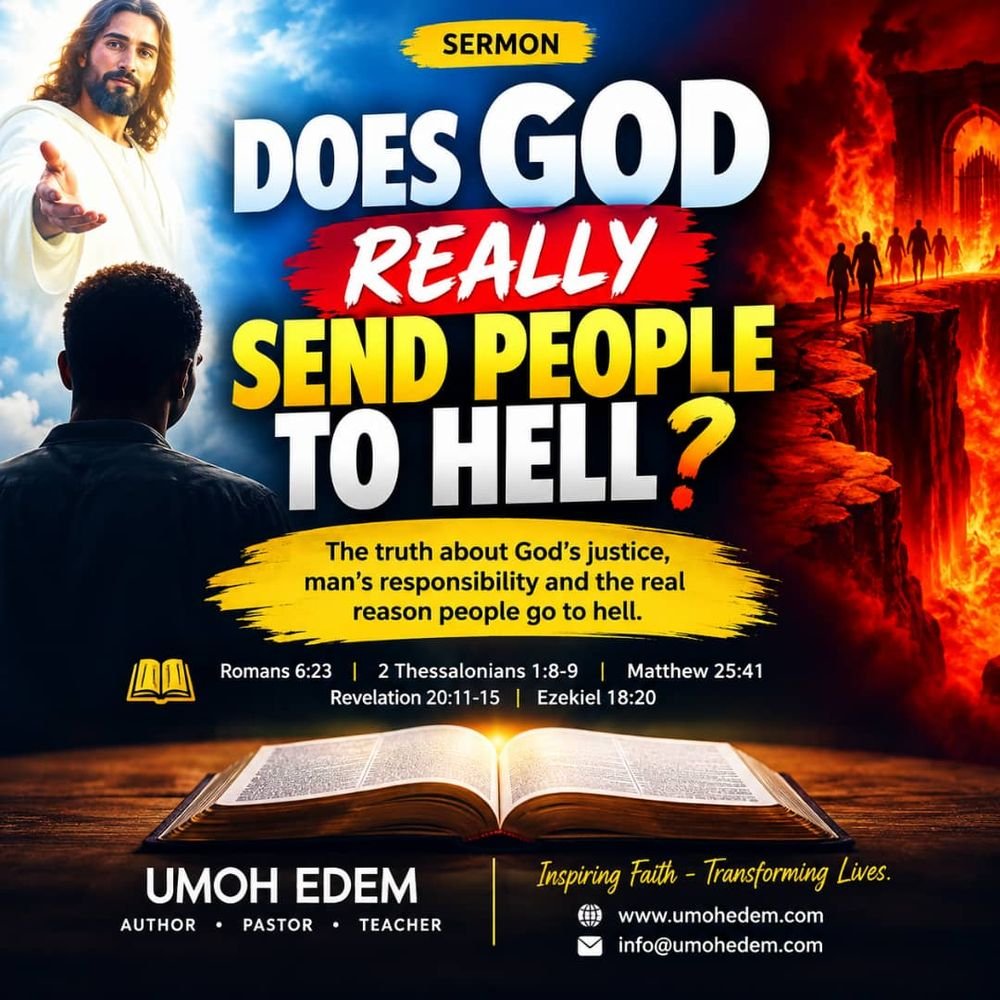
This is a deeply important question because Scripture speaks both about God’s love and mercy and about His judgment and eternal punishment. Let’s present it carefully rather than reducing it to either “God sends people to hell” or “God would never send anyone to hell.”
DOES GOD REALLY SEND PEOPLE TO HELL?
What Does the Bible Really Teach?
Few subjects create as much emotional and theological discussion as the doctrine of hell.
Some people ask:
“If God is love, why would He send anyone to hell?”
Others ask:
“If hell is real, why would a loving God allow people to go there?”
Some even argue:
“A loving God would never punish anyone eternally.”
These are serious questions.
The Bible does not avoid them. Scripture speaks about God’s love, His mercy, His patience, His desire for people to repent, His righteous judgment, and the reality of final punishment.
So, does God really send people to hell?
To answer responsibly, we must allow the whole counsel of Scripture to speak.
- DOES THE BIBLE REALLY TEACH THAT HELL EXISTS?
Yes.
Jesus Himself spoke repeatedly about final judgment.
He warned:
«“Fear him which is able to destroy both soul and body in hell.”
— Matthew 10:28»
Jesus also spoke of the final separation between the righteous and the wicked:
«“And these shall go away into everlasting punishment: but the righteous into life eternal.”
— Matthew 25:46»
The New Testament also speaks about:
- judgment,
- eternal punishment,
- the lake of fire,
- exclusion from God’s kingdom,
- the final judgment,
- and the consequences of rejecting God.
Therefore, Christians should not dismiss hell simply because the subject is uncomfortable.
If Jesus warned about it, we should take the warning seriously.
2. BUT GOD IS LOVE
The Bible clearly says:
«“God is love.”
— 1 John 4:8»
God is not cruel.
He is not looking for reasons to condemn people.
Scripture describes Him as:
«“merciful and gracious, longsuffering, and abundant in goodness and truth.”
— Exodus 34:6»
Peter says:
«“The Lord is… longsuffering to us-ward, not willing that any should perish, but that all should come to repentance.”
— 2 Peter 3:9»
This is essential to understanding biblical judgment.
God’s judgment does not mean that God takes pleasure in human suffering.
The Bible presents Him as a God who calls people to repentance and offers salvation.
3. GOD DOES NOT DELIGHT IN THE DEATH OF THE WICKED
This is one of the most important passages to understand.
God says through the prophet Ezekiel:
«“Have I any pleasure at all that the wicked should die? saith the Lord GOD: and not that he should return from his ways, and live?”
— Ezekiel 18:23»
Again:
«“For I have no pleasure in the death of him that dieth, saith the Lord GOD: wherefore turn yourselves, and live ye.”
— Ezekiel 18:32»
The message is clear:
God calls people to turn and live.
He does not present repentance as something He hates.
He invites sinners to return to Him.
4. THEN WHY IS THERE JUDGMENT?
Because God is not only loving.
God is also righteous and just.
Imagine a judge who allows every murderer, rapist, fraudster, trafficker, abuser, and violent criminal to walk away without judgment.
Would we call that justice?
Probably not.
We naturally understand that genuine evil requires justice.
The Bible teaches that God is the ultimate righteous Judge.
«“Shall not the Judge of all the earth do right?”
— Genesis 18:25»
God’s judgment is therefore not a contradiction of His goodness.
His goodness includes His justice.
5. GOD’S JUDGMENT IS NOT AN UNCONTROLLED EMOTIONAL REACTION.
Human beings sometimes punish others because of anger, revenge, hatred, or personal resentment.
God’s judgment is different.
Abraham asked:
«“Shall not the Judge of all the earth do right?”»
The biblical picture is that God’s judgment is righteous and perfectly informed.
God sees what human beings cannot see.
He knows the heart.
He knows every action.
He knows every motive.
He knows every opportunity a person had to respond to truth.
Paul writes:
«“The day when God shall judge the secrets of men by Jesus Christ.”
— Romans 2:16»
Therefore, we should be careful about making confident judgments concerning the eternal destiny of particular individuals.
God is the Judge. We are not.
6. IS HELL GOD’S DESIRE FOR HUMANITY?
Jesus’ words in Matthew 25:41 are important.
He describes the final judgment and says:
«“Depart from me, ye cursed, into everlasting fire, prepared for the devil and his angels.”»
Notice something significant:
The text describes the fire as having been “prepared for the devil and his angels.”
Scripture’s larger message is that God calls humanity toward salvation, not destruction.
Jesus came to save.
John 3:16 says:
«“For God so loved the world, that he gave his only begotten Son, that whosoever believeth in him should not perish, but have everlasting life.”»
The Gospel is therefore an invitation:
Turn to Christ. Receive forgiveness. Be reconciled to God.
7. WHAT ABOUT JOHN 3:16?
John 3:16 is perhaps the most famous summary of God’s saving love:
«“For God so loved the world, that he gave his only begotten Son…”»
Notice what follows:
«“that whosoever believeth in him should not perish, but have everlasting life.”»
This verse presents two destinations:
Perishing
and
Everlasting life.
The Gospel is not simply:
“God loves you.”
It is:
“God loves you and has provided salvation through Jesus Christ.”
That is why the message of the Gospel is urgent.
8. DOES GOD FORCE PEOPLE TO GO TO HELL?
Scripture presents human beings as morally responsible for their response to God.
Jesus said:
«“Ye will not come to me, that ye might have life.”
— John 5:40»
He also lamented over Jerusalem:
«“How often would I have gathered thy children together… and ye would not!”
— Matthew 23:37»
The Bible repeatedly calls people to:
- repent,
- believe,
- turn to God,
- receive Christ,
- and follow Him.
Therefore, Scripture does not portray people as helpless victims of a God who simply wants to condemn them.
God extends an invitation.
Human beings are called to respond.
- BUT ISN’T SALVATION A FREE GIFT?
Yes.
Salvation cannot be earned through human achievement.
Paul says:
«“For by grace are ye saved through faith; and that not of yourselves: it is the gift of God.”
— Ephesians 2:8»
This means nobody can stand before God and say:
“I saved myself.”
Salvation is God’s gracious provision through Christ.
But the fact that salvation is free does not mean that rejecting God’s provision has no consequences.
A person can be offered forgiveness and refuse it.
A person can be offered reconciliation and reject it.
A person can hear the Gospel and refuse Christ.
The Gospel therefore presents both:
an invitation
and
a warning. - WHAT ABOUT PEOPLE WHO HAVE NEVER HEARD THE GOSPEL?
This is one of the most difficult questions.
Romans 1 and 2 teach that God’s revelation through creation and conscience leaves humanity accountable before Him.
Paul writes:
«“For the wrath of God is revealed from heaven against all ungodliness and unrighteousness of men.”
— Romans 1:18»
He also teaches that God judges people righteously.
However, Scripture does not give us enough information to determine the eternal destiny of every individual who has never heard a Christian preacher.
Therefore, we should avoid making confident statements about specific people.
We can confidently say:
God is perfectly just.
God knows every heart.
God knows what every person has received and understood.
God will judge righteously.
11. WHAT ABOUT BABIES AND YOUNG CHILDREN?
This question also requires humility.
Scripture teaches that God is righteous and merciful.
David, after the death of his infant son, expressed confidence that he would one day go to him:
«“I shall go to him, but he shall not return to me.”
— 2 Samuel 12:23»
Christians have developed different theological explanations concerning the salvation and accountability of children.
But Scripture does not give us a complete systematic explanation of every case.
Therefore, rather than making dogmatic claims beyond Scripture, we can rest in the character of God:
The Judge of all the earth will do what is right.
12. IS HELL ETERNAL?
This is another major theological discussion.
Jesus uses the expression:
«“everlasting punishment”
— Matthew 25:46»
The same verse contrasts this with:
«“life eternal.”»
Many Christians therefore understand hell as involving conscious, final, and everlasting punishment.
However, some Christians interpret the biblical language as teaching final destruction or annihilation rather than everlasting conscious suffering.
This view is sometimes called conditional immortality or annihilationism.
There is also disagreement over how certain biblical descriptions of hell—such as “fire,” “destruction,” and “outer darkness”—should be understood.
The important point for this page is:
Christians have theological disagreements about the precise nature of final punishment, but the New Testament clearly presents final judgment as a serious reality that should not be ignored.
13. WHY DID JESUS SPEAK SO MUCH ABOUT JUDGMENT?
Because He wanted people to understand the seriousness of their spiritual condition.
Jesus did not warn about judgment because He hated people.
He warned because He came to save them.
A doctor who discovers a life-threatening disease does not love the patient by hiding the diagnosis.
Likewise, Jesus did not hide the consequences of rejecting God.
His warnings were part of His call to repentance.
14. GOD’S LOVE DOES NOT CANCEL GOD’S JUSTICE.
Some people say:
“God is love, therefore nobody can go to hell.”
But this reasoning creates a problem.
If God’s love means He can never judge evil, then what happens to justice?
What happens to victims of violence?
What happens to those who have suffered terrible injustice?
What happens to evil that human courts never discovered?
The biblical answer is that there is ultimately a righteous Judge.
God’s love and God’s justice are not enemies.
His love is holy, and His justice is righteous.
The cross of Christ demonstrates both.
At the cross, we see God’s love toward sinners and the seriousness of sin at the same time.
15. THE CROSS SHOWS HOW SERIOUS SIN IS.
Romans 5:8 says:
«“But God commendeth his love toward us, in that, while we were yet sinners, Christ died for us.”»
Think about that.
God did not ignore sin.
He did not simply say:
“Sin doesn’t matter.”
Instead, He provided redemption through Christ.
The cross tells us two things simultaneously:
SIN IS SERIOUS.
And:
GOD’S LOVE IS GREATER THAN OUR SIN.
That is the heart of the Gospel.
16. DON’T ASSUME THAT EVERYONE WHO DIES IS IN HELL.
This is a crucial pastoral point.
Christians sometimes speak carelessly about the eternal destiny of people who have died.
We should not.
We do not possess God’s complete knowledge of another person’s final spiritual condition.
We can preach the Gospel while people are alive.
We can call people to repentance.
But we should leave final judgment to God.
Paul says:
«“Who art thou that judgest another man’s servant? to his own master he standeth or falleth.”
— Romans 14:4»
God is the Judge.
17. THE PURPOSE OF THIS MESSAGE IS NOT TO SCARE YOU.
Hell should certainly make us take eternity seriously.
But the Christian message is not merely:
“Escape hell.”
The greater message is:
“Be reconciled to God through Jesus Christ.”
Jesus did not come merely to make people afraid of punishment.
He came to give eternal life.
He came to forgive sins.
He came to restore broken people.
He came to reconcile sinners to God.
He came to make us children of God.
18. WHAT SHOULD WE DO WITH THIS TRUTH?
- TAKE ETERNITY SERIOUSLY.
Life is temporary.
Eternity is not.
James reminds us that our earthly life is like a vapor.
«“For what is your life? It is even a vapour, that appeareth for a little time, and then vanisheth away.”
— James 4:14» - REPENT
Jesus’ message was:
«“Repent ye, and believe the gospel.”
— Mark 1:15» - BELIEVE IN CHRIST.
Salvation is found in Jesus Christ.
«“Believe on the Lord Jesus Christ, and thou shalt be saved.”
— Acts 16:31» - DON’T PLAY WITH SIN.
Sin is not harmless.
It destroys lives and separates people from God. - SHARE THE GOSPEL.
If we genuinely believe eternity matters, we should care about the eternal condition of others.
But share Christ with:
truth, love, humility, patience, and compassion.
SO, DOES GOD REALLY SEND PEOPLE TO HELL?
A careful biblical answer:
Yes, Scripture teaches that God will ultimately judge humanity and that those who remain in rebellion and reject His salvation face final punishment.
But it would be misleading to portray God as a cruel being who takes pleasure in sending people to hell.
The Bible presents God as:
loving,
merciful,
patient,
just,
holy,
and calling people to repentance.
He sent His Son so that people could be saved.
«“For God sent not his Son into the world to condemn the world; but that the world through him might be saved.”
— John 3:17»
That verse is essential.
God’s mission in Christ is salvation.
Yet Scripture also teaches that God’s final judgment is real.
Therefore, the biblical message is neither:
“God doesn’t care what people do.”
nor:
“God is looking for people to punish.”
The biblical message is:
God offers salvation through Christ, calls people to repentance, and will ultimately judge with perfect righteousness.
THE GREATER QUESTION.
Perhaps the most important question is not:
“Does God send people to hell?”
The more personal question is:
“What am I doing with God’s offer of salvation through Jesus Christ?”
We cannot control every theological question about eternity.
But we can respond to Christ today.
We can repent.
We can believe.
We can surrender.
We can follow Jesus.
We can share the Gospel.
And we can live with eternity in view.
FINAL REFLECTION.
If there is a real judgment, then eternity matters.
If there is a real Savior, then His invitation matters.
If Christ really died for sinners, then the cross matters.
And if God is calling people to repentance, then today matters.
«“Behold, now is the accepted time; behold, now is the day of salvation.”
— 2 Corinthians 6:2»
Do not wait until tomorrow to respond to God.
Do not allow pride to keep you from repentance.
Do not allow religious tradition to replace a relationship with Christ.
Do not allow fear to prevent you from approaching God.
Come to Christ.
REFLECTION QUESTIONS.
- What do I believe about eternity, and why?
- Do I understand the difference between God’s love and sentimentalism?
- Have I genuinely surrendered my life to Jesus Christ?
- Am I taking sin and repentance seriously?
- Do I treat God’s mercy as permission to continue in sin?
- How should the reality of eternity change the way I live today?
- Am I sharing the Gospel with others through both my words and my life?
PRAYER.
Heavenly Father, thank You for Your great love and mercy. Thank You for sending Jesus Christ to provide salvation for sinners. Give me a heart that fears You, loves You, and obeys Your Word. Help me never to take Your grace for granted. Give me the courage to repent of sin, the faith to trust Christ, and the compassion to share the Gospel with others. Help me live every day with eternity in view. May my life bring glory to You and point others toward Jesus Christ. In Jesus’ name, Amen.
BIBLICAL TRUTH.
God is love, but God is also holy and just. Scripture teaches both the reality of God’s saving mercy and the reality of final judgment. We should therefore neither minimize hell nor misrepresent God’s character.
God calls people to repentance. Christ offers salvation. The Gospel is an invitation to life.
«“The Lord is… not willing that any should perish, but that all should come to repentance.”
— 2 Peter 3:9»
Read the Scriptures. Examine the context. Seek God sincerely. And let the truth of His Word shape your life.
— UMOH EDEM
Biblical Teacher | Christian Author | Gospel Communicator
BIBLICAL TRUTH & CONTROVERSIAL ISSUES.
Examining Difficult Questions Through the Light of Scripture.
DOES GOD REALLY SEND PEOPLE TO HELL?
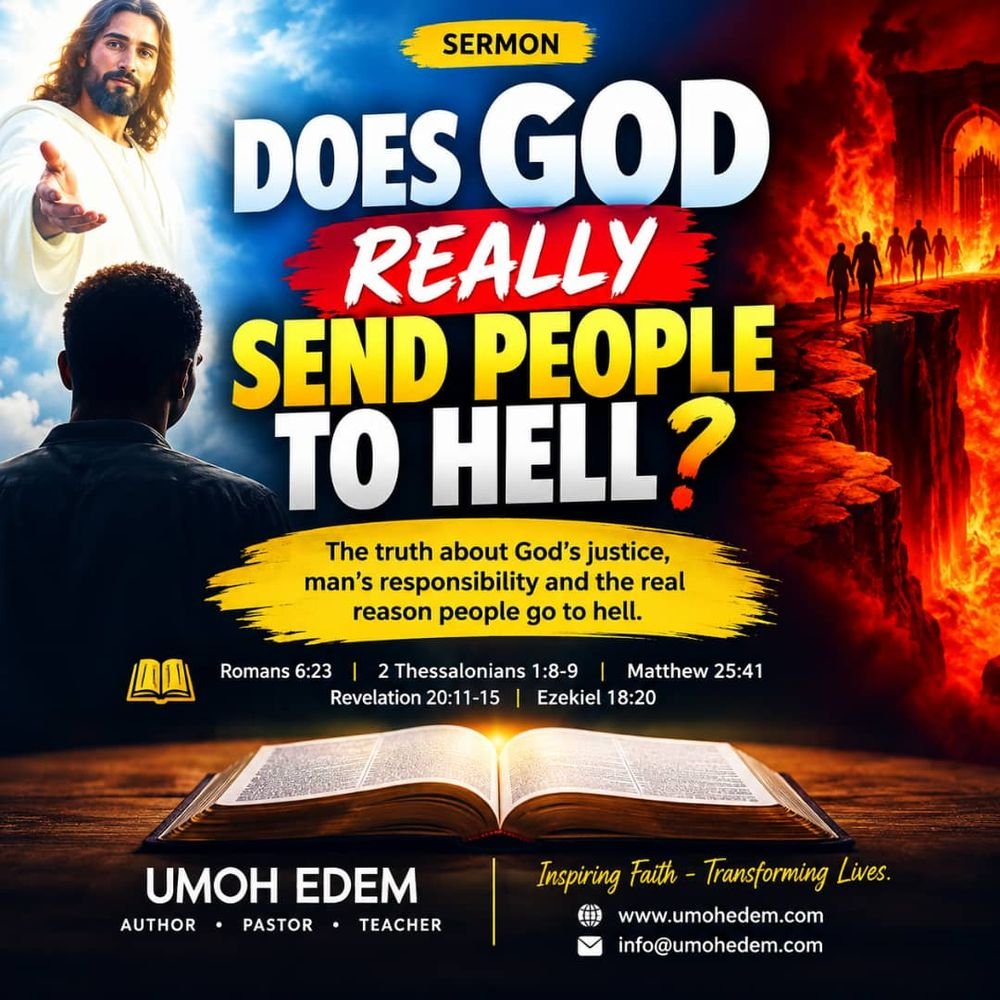
This is a deeply important question because Scripture speaks both about God’s love and mercy and about His judgment and eternal punishment. Let’s present it carefully rather than reducing it to either “God sends people to hell” or “God would never send anyone to hell.”
DOES GOD REALLY SEND PEOPLE TO HELL?
What Does the Bible Really Teach?
Few subjects create as much emotional and theological discussion as the doctrine of hell.
Some people ask:
“If God is love, why would He send anyone to hell?”
Others ask:
“If hell is real, why would a loving God allow people to go there?”
Some even argue:
“A loving God would never punish anyone eternally.”
These are serious questions.
The Bible does not avoid them. Scripture speaks about God’s love, His mercy, His patience, His desire for people to repent, His righteous judgment, and the reality of final punishment.
So, does God really send people to hell?
To answer responsibly, we must allow the whole counsel of Scripture to speak.
- DOES THE BIBLE REALLY TEACH THAT HELL EXISTS?
Yes.
Jesus Himself spoke repeatedly about final judgment.
He warned:
«“Fear him which is able to destroy both soul and body in hell.”
— Matthew 10:28»
Jesus also spoke of the final separation between the righteous and the wicked:
«“And these shall go away into everlasting punishment: but the righteous into life eternal.”
— Matthew 25:46»
The New Testament also speaks about:
- judgment,
- eternal punishment,
- the lake of fire,
- exclusion from God’s kingdom,
- the final judgment,
- and the consequences of rejecting God.
Therefore, Christians should not dismiss hell simply because the subject is uncomfortable.
If Jesus warned about it, we should take the warning seriously.
2. BUT GOD IS LOVE
The Bible clearly says:
«“God is love.”
— 1 John 4:8»
God is not cruel.
He is not looking for reasons to condemn people.
Scripture describes Him as:
«“merciful and gracious, longsuffering, and abundant in goodness and truth.”
— Exodus 34:6»
Peter says:
«“The Lord is… longsuffering to us-ward, not willing that any should perish, but that all should come to repentance.”
— 2 Peter 3:9»
This is essential to understanding biblical judgment.
God’s judgment does not mean that God takes pleasure in human suffering.
The Bible presents Him as a God who calls people to repentance and offers salvation.
3. GOD DOES NOT DELIGHT IN THE DEATH OF THE WICKED
This is one of the most important passages to understand.
God says through the prophet Ezekiel:
«“Have I any pleasure at all that the wicked should die? saith the Lord GOD: and not that he should return from his ways, and live?”
— Ezekiel 18:23»
Again:
«“For I have no pleasure in the death of him that dieth, saith the Lord GOD: wherefore turn yourselves, and live ye.”
— Ezekiel 18:32»
The message is clear:
God calls people to turn and live.
He does not present repentance as something He hates.
He invites sinners to return to Him.
4. THEN WHY IS THERE JUDGMENT?
Because God is not only loving.
God is also righteous and just.
Imagine a judge who allows every murderer, rapist, fraudster, trafficker, abuser, and violent criminal to walk away without judgment.
Would we call that justice?
Probably not.
We naturally understand that genuine evil requires justice.
The Bible teaches that God is the ultimate righteous Judge.
«“Shall not the Judge of all the earth do right?”
— Genesis 18:25»
God’s judgment is therefore not a contradiction of His goodness.
His goodness includes His justice.
5. GOD’S JUDGMENT IS NOT AN UNCONTROLLED EMOTIONAL REACTION.
Human beings sometimes punish others because of anger, revenge, hatred, or personal resentment.
God’s judgment is different.
Abraham asked:
«“Shall not the Judge of all the earth do right?”»
The biblical picture is that God’s judgment is righteous and perfectly informed.
God sees what human beings cannot see.
He knows the heart.
He knows every action.
He knows every motive.
He knows every opportunity a person had to respond to truth.
Paul writes:
«“The day when God shall judge the secrets of men by Jesus Christ.”
— Romans 2:16»
Therefore, we should be careful about making confident judgments concerning the eternal destiny of particular individuals.
God is the Judge. We are not.
6. IS HELL GOD’S DESIRE FOR HUMANITY?
Jesus’ words in Matthew 25:41 are important.
He describes the final judgment and says:
«“Depart from me, ye cursed, into everlasting fire, prepared for the devil and his angels.”»
Notice something significant:
The text describes the fire as having been “prepared for the devil and his angels.”
Scripture’s larger message is that God calls humanity toward salvation, not destruction.
Jesus came to save.
John 3:16 says:
«“For God so loved the world, that he gave his only begotten Son, that whosoever believeth in him should not perish, but have everlasting life.”»
The Gospel is therefore an invitation:
Turn to Christ. Receive forgiveness. Be reconciled to God.
7. WHAT ABOUT JOHN 3:16?
John 3:16 is perhaps the most famous summary of God’s saving love:
«“For God so loved the world, that he gave his only begotten Son…”»
Notice what follows:
«“that whosoever believeth in him should not perish, but have everlasting life.”»
This verse presents two destinations:
Perishing
and
Everlasting life.
The Gospel is not simply:
“God loves you.”
It is:
“God loves you and has provided salvation through Jesus Christ.”
That is why the message of the Gospel is urgent.
8. DOES GOD FORCE PEOPLE TO GO TO HELL?
Scripture presents human beings as morally responsible for their response to God.
Jesus said:
«“Ye will not come to me, that ye might have life.”
— John 5:40»
He also lamented over Jerusalem:
«“How often would I have gathered thy children together… and ye would not!”
— Matthew 23:37»
The Bible repeatedly calls people to:
- repent,
- believe,
- turn to God,
- receive Christ,
- and follow Him.
Therefore, Scripture does not portray people as helpless victims of a God who simply wants to condemn them.
God extends an invitation.
Human beings are called to respond.
- BUT ISN’T SALVATION A FREE GIFT?
Yes.
Salvation cannot be earned through human achievement.
Paul says:
«“For by grace are ye saved through faith; and that not of yourselves: it is the gift of God.”
— Ephesians 2:8»
This means nobody can stand before God and say:
“I saved myself.”
Salvation is God’s gracious provision through Christ.
But the fact that salvation is free does not mean that rejecting God’s provision has no consequences.
A person can be offered forgiveness and refuse it.
A person can be offered reconciliation and reject it.
A person can hear the Gospel and refuse Christ.
The Gospel therefore presents both:
an invitation
and
a warning. - WHAT ABOUT PEOPLE WHO HAVE NEVER HEARD THE GOSPEL?
This is one of the most difficult questions.
Romans 1 and 2 teach that God’s revelation through creation and conscience leaves humanity accountable before Him.
Paul writes:
«“For the wrath of God is revealed from heaven against all ungodliness and unrighteousness of men.”
— Romans 1:18»
He also teaches that God judges people righteously.
However, Scripture does not give us enough information to determine the eternal destiny of every individual who has never heard a Christian preacher.
Therefore, we should avoid making confident statements about specific people.
We can confidently say:
God is perfectly just.
God knows every heart.
God knows what every person has received and understood.
God will judge righteously.
11. WHAT ABOUT BABIES AND YOUNG CHILDREN?
This question also requires humility.
Scripture teaches that God is righteous and merciful.
David, after the death of his infant son, expressed confidence that he would one day go to him:
«“I shall go to him, but he shall not return to me.”
— 2 Samuel 12:23»
Christians have developed different theological explanations concerning the salvation and accountability of children.
But Scripture does not give us a complete systematic explanation of every case.
Therefore, rather than making dogmatic claims beyond Scripture, we can rest in the character of God:
The Judge of all the earth will do what is right.
12. IS HELL ETERNAL?
This is another major theological discussion.
Jesus uses the expression:
«“everlasting punishment”
— Matthew 25:46»
The same verse contrasts this with:
«“life eternal.”»
Many Christians therefore understand hell as involving conscious, final, and everlasting punishment.
However, some Christians interpret the biblical language as teaching final destruction or annihilation rather than everlasting conscious suffering.
This view is sometimes called conditional immortality or annihilationism.
There is also disagreement over how certain biblical descriptions of hell—such as “fire,” “destruction,” and “outer darkness”—should be understood.
The important point for this page is:
Christians have theological disagreements about the precise nature of final punishment, but the New Testament clearly presents final judgment as a serious reality that should not be ignored.
13. WHY DID JESUS SPEAK SO MUCH ABOUT JUDGMENT?
Because He wanted people to understand the seriousness of their spiritual condition.
Jesus did not warn about judgment because He hated people.
He warned because He came to save them.
A doctor who discovers a life-threatening disease does not love the patient by hiding the diagnosis.
Likewise, Jesus did not hide the consequences of rejecting God.
His warnings were part of His call to repentance.
14. GOD’S LOVE DOES NOT CANCEL GOD’S JUSTICE.
Some people say:
“God is love, therefore nobody can go to hell.”
But this reasoning creates a problem.
If God’s love means He can never judge evil, then what happens to justice?
What happens to victims of violence?
What happens to those who have suffered terrible injustice?
What happens to evil that human courts never discovered?
The biblical answer is that there is ultimately a righteous Judge.
God’s love and God’s justice are not enemies.
His love is holy, and His justice is righteous.
The cross of Christ demonstrates both.
At the cross, we see God’s love toward sinners and the seriousness of sin at the same time.
15. THE CROSS SHOWS HOW SERIOUS SIN IS.
Romans 5:8 says:
«“But God commendeth his love toward us, in that, while we were yet sinners, Christ died for us.”»
Think about that.
God did not ignore sin.
He did not simply say:
“Sin doesn’t matter.”
Instead, He provided redemption through Christ.
The cross tells us two things simultaneously:
SIN IS SERIOUS.
And:
GOD’S LOVE IS GREATER THAN OUR SIN.
That is the heart of the Gospel.
16. DON’T ASSUME THAT EVERYONE WHO DIES IS IN HELL.
This is a crucial pastoral point.
Christians sometimes speak carelessly about the eternal destiny of people who have died.
We should not.
We do not possess God’s complete knowledge of another person’s final spiritual condition.
We can preach the Gospel while people are alive.
We can call people to repentance.
But we should leave final judgment to God.
Paul says:
«“Who art thou that judgest another man’s servant? to his own master he standeth or falleth.”
— Romans 14:4»
God is the Judge.
17. THE PURPOSE OF THIS MESSAGE IS NOT TO SCARE YOU.
Hell should certainly make us take eternity seriously.
But the Christian message is not merely:
“Escape hell.”
The greater message is:
“Be reconciled to God through Jesus Christ.”
Jesus did not come merely to make people afraid of punishment.
He came to give eternal life.
He came to forgive sins.
He came to restore broken people.
He came to reconcile sinners to God.
He came to make us children of God.
18. WHAT SHOULD WE DO WITH THIS TRUTH?
- TAKE ETERNITY SERIOUSLY.
Life is temporary.
Eternity is not.
James reminds us that our earthly life is like a vapor.
«“For what is your life? It is even a vapour, that appeareth for a little time, and then vanisheth away.”
— James 4:14» - REPENT
Jesus’ message was:
«“Repent ye, and believe the gospel.”
— Mark 1:15» - BELIEVE IN CHRIST.
Salvation is found in Jesus Christ.
«“Believe on the Lord Jesus Christ, and thou shalt be saved.”
— Acts 16:31» - DON’T PLAY WITH SIN.
Sin is not harmless.
It destroys lives and separates people from God. - SHARE THE GOSPEL.
If we genuinely believe eternity matters, we should care about the eternal condition of others.
But share Christ with:
truth, love, humility, patience, and compassion.
SO, DOES GOD REALLY SEND PEOPLE TO HELL?
A careful biblical answer:
Yes, Scripture teaches that God will ultimately judge humanity and that those who remain in rebellion and reject His salvation face final punishment.
But it would be misleading to portray God as a cruel being who takes pleasure in sending people to hell.
The Bible presents God as:
loving,
merciful,
patient,
just,
holy,
and calling people to repentance.
He sent His Son so that people could be saved.
«“For God sent not his Son into the world to condemn the world; but that the world through him might be saved.”
— John 3:17»
That verse is essential.
God’s mission in Christ is salvation.
Yet Scripture also teaches that God’s final judgment is real.
Therefore, the biblical message is neither:
“God doesn’t care what people do.”
nor:
“God is looking for people to punish.”
The biblical message is:
God offers salvation through Christ, calls people to repentance, and will ultimately judge with perfect righteousness.
THE GREATER QUESTION.
Perhaps the most important question is not:
“Does God send people to hell?”
The more personal question is:
“What am I doing with God’s offer of salvation through Jesus Christ?”
We cannot control every theological question about eternity.
But we can respond to Christ today.
We can repent.
We can believe.
We can surrender.
We can follow Jesus.
We can share the Gospel.
And we can live with eternity in view.
FINAL REFLECTION.
If there is a real judgment, then eternity matters.
If there is a real Savior, then His invitation matters.
If Christ really died for sinners, then the cross matters.
And if God is calling people to repentance, then today matters.
«“Behold, now is the accepted time; behold, now is the day of salvation.”
— 2 Corinthians 6:2»
Do not wait until tomorrow to respond to God.
Do not allow pride to keep you from repentance.
Do not allow religious tradition to replace a relationship with Christ.
Do not allow fear to prevent you from approaching God.
Come to Christ.
REFLECTION QUESTIONS.
- What do I believe about eternity, and why?
- Do I understand the difference between God’s love and sentimentalism?
- Have I genuinely surrendered my life to Jesus Christ?
- Am I taking sin and repentance seriously?
- Do I treat God’s mercy as permission to continue in sin?
- How should the reality of eternity change the way I live today?
- Am I sharing the Gospel with others through both my words and my life?
PRAYER.
Heavenly Father, thank You for Your great love and mercy. Thank You for sending Jesus Christ to provide salvation for sinners. Give me a heart that fears You, loves You, and obeys Your Word. Help me never to take Your grace for granted. Give me the courage to repent of sin, the faith to trust Christ, and the compassion to share the Gospel with others. Help me live every day with eternity in view. May my life bring glory to You and point others toward Jesus Christ. In Jesus’ name, Amen.
BIBLICAL TRUTH.
God is love, but God is also holy and just. Scripture teaches both the reality of God’s saving mercy and the reality of final judgment. We should therefore neither minimize hell nor misrepresent God’s character.
God calls people to repentance. Christ offers salvation. The Gospel is an invitation to life.
«“The Lord is… not willing that any should perish, but that all should come to repentance.”
— 2 Peter 3:9»
Read the Scriptures. Examine the context. Seek God sincerely. And let the truth of His Word shape your life.
— UMOH EDEM
Biblical Teacher | Christian Author | Gospel Communicator
BIBLICAL TRUTH & CONTROVERSIAL ISSUES.
Examining Difficult Questions Through the Light of Scripture.